Summary:
High-volume automated data gathering, multi-region SEO tracking, and large-scale marketing tasks fail when your underlying network architecture cannot handle the stress. For intense automation pipelines, relying on basic or free network tools leads to rapid IP bans, constant CAPTCHAs, and corrupted business intelligence data. This field-tested guide breaks down why standard IP addresses fail under high-volume stress, analyzes which specific, high-tier proxy frameworks can sustain millions of requests, and details how modern data analysts use OkkProxy’s premium global infrastructure to achieve flawless data retrieval at scale.
Why Standard Networks Crash Under Heavy API Workloads

You have built a scalable data gathering script, optimized your connection pools, and tailored your target endpoints. Yet, the moment your daily volume scales from thousands of requests to millions, the entire operation halts. Your system dashboards fill with 429 Too Many Requests, 403 Forbidden, and sudden, unexplained connection timeouts.
The core issue is rarely your application logic; it is almost always your proxy infrastructure.
When executing high-frequency data extraction or multi-account management, the primary bottleneck shifts from simple network bandwidth to anti-bot evasion, rate-limit management, and IP address reputation scores. Standard IP addresses and entry-level server proxies simply lack the diversity and structural trust scores needed to bypass modern, enterprise-grade anti-scraping systems like Cloudflare, DataDome, or Akamai.
To build a data collection pipeline capable of handling intense automation without interruption, you must invest in the best proxies for heavy API usage.
What Actually Is an API Proxy vs. Standard IP Rotation?
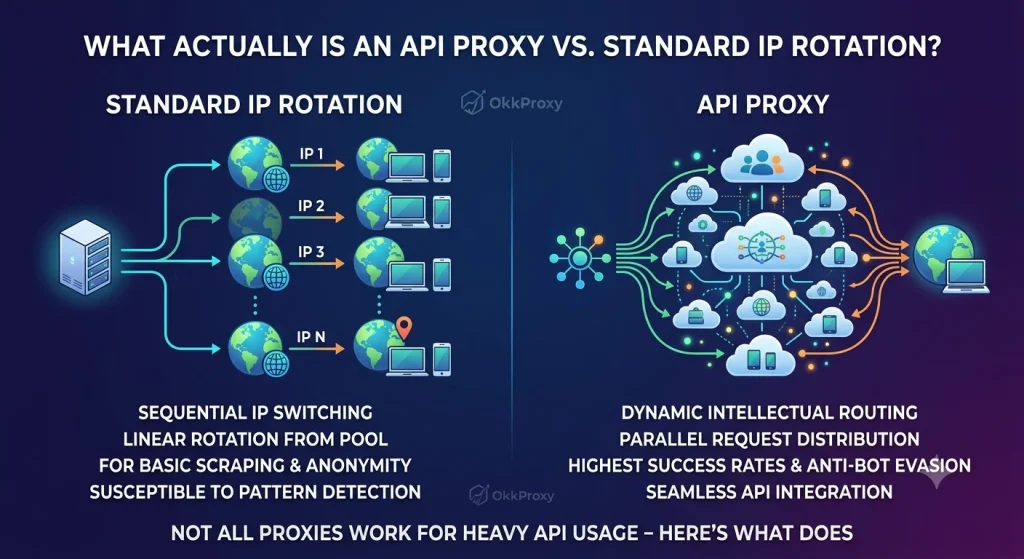
For digital marketers and data teams entering the research phase, terminology can easily become confusing. Understanding how different routing mechanisms process data determines whether your project scales or stalls.
Understanding the Intermediary Layers
An api proxy or api proxy server functions as an abstraction layer positioned directly between your application scripts and the target platform you are querying. It manages essential data routing, obfuscates your primary server’s location, and handles basic request authorization.
However, in large-scale data harvesting or multi-region tracking, a software-only API gateway is not enough. You need a physical network layer—a dedicated proxy api service or scraper api proxy—that injects thousands of highly trusted, unique IP addresses into that stream. This ensures that every individual request appears to originate from an completely unique, distinct user location globally.
Comparing Enterprise Routing Infrastructures
To see how different routing strategies perform under intense, high-frequency enterprise demands, review the operational breakdown below:
| Performance Metric | Premium Proxy API Service (e.g., OkkProxy) | Public / Free Proxy API List | Standard Cloud Infrastructure IPs |
| IP Address Trust Score | Maximum. Verified residential, mobile, and legitimate ISP allocations. | Critical Failure. Heavily blacklisted across global databases. | Low. Flags instantly as automated server farm traffic. |
| IP Pool Diversity | Millions of unique nodes spread across 150+ countries. | Minimal active endpoints, frequently going offline mid-session. | Restricted to a small block of identical data center subnets. |
| Anti-Bot Evasion Rate | Greater than 99% success against advanced fingerprinting shields. | Less than 5%. Blocked immediately by edge firewalls. | Medium-Low. Blocked as soon as request limits are crossed. |
| Operational Security | End-to-end data encryption with private access tokens. | Severe risk of data sniffing, payload injections, and leaks. | Secure data channels but highly exposed to target destination bans. |
Selecting the Best Proxies for Heavy API Usage: 5 Specialized Options
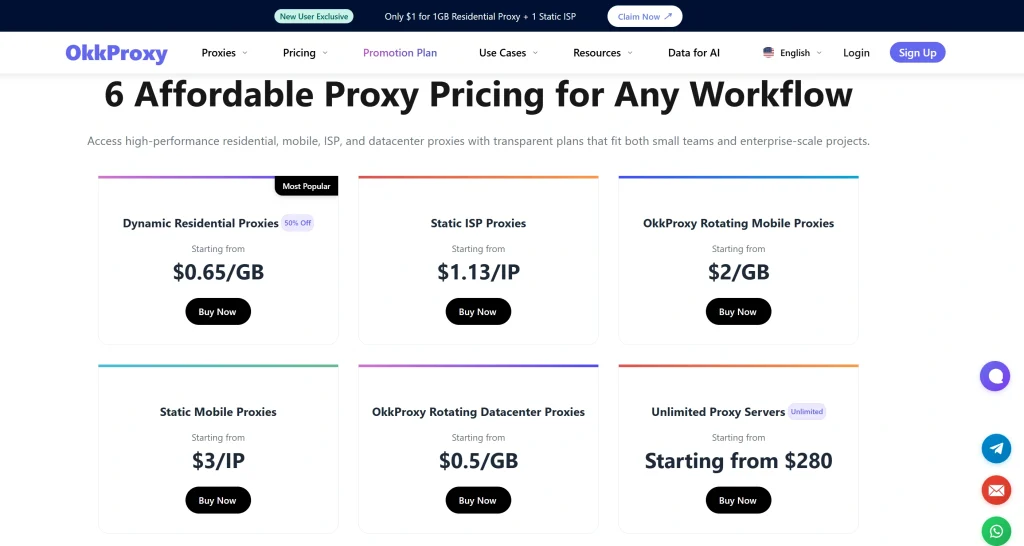
Different business tasks require different network architectures. Using the wrong tool for the job causes unnecessary expenses and high failure rates. Below are the five enterprise-tier options capable of sustaining heavy data extraction and automation pipelines.
1. Rotating Residential Proxies: The Definitive Choice for Web Scraping
When your core operational challenge is bypassing aggressive anti-scraping firewalls on highly protected data hubs, a rotating proxy api built on residential connections is essential.
- The Mechanics: A residential proxy api routes your outbound data queries through authentic home internet connections assigned by real Internet Service Providers (ISPs). Because these IP addresses belong to genuine households, target platforms cannot ban them without blocking their own real customers.
- The Business Benefit: OkkProxy’s rotating residential proxies provide access to an expansive global network of over 60 million real residential IPs. Featuring automated rotation that refreshes on every individual request, this service lets your data collection scripts match real human browsing habits perfectly. This eliminates rate limits and provides clean data access across even the most stringently protected e-commerce and social networks.
2. Static ISP Proxies: Session Stability for Multi-Account Operations
Not all heavy automated tasks require a new IP address for every single request. Tasks like cross-border ad verification, localized SEO tracking, and multi-profile digital marketing need an IP to stay exactly the same for hours or days at a time.
- The Mechanics: Also known as static residential proxies, these combine the speed and processing power of a premium data center host with the highly trusted reputation of a real residential consumer ISP line.
- The Business Benefit: OkkProxy’s static ISP proxies deliver consistent session persistence with zero connection drops. Your marketing automation suites can run for extended periods using a single, high-reputation IP address. This removes the risk of sudden session drops, account logouts, or multi-factor authentication locks.
3. Rotating Mobile Proxies: Overcoming Strict Mobile App Defenses
Modern social networks and mobile application platforms utilize advanced mobile-device fingerprinting to protect their internal systems. Standard data center configurations are flagged by these platforms instantly.
- The Mechanics: These proxies route your data traffic directly through real cellular carrier networks (4G/5G/LTE). Mobile networks use Carrier-Grade NAT (CGNAT) technology, meaning thousands of actual mobile phone users share a single public IP address simultaneously. Security firewalls avoid blocking these IPs because a blanket ban would lock out hundreds of real customers.
- The Business Benefit: Integrating a mobile proxy api for mobile app scraping through OkkProxy’s rotating mobile proxies gives your data teams access to clean cellular carrier networks. This setup makes it easy to bypass strict mobile app restrictions and retrieve highly accurate consumer trend data.
4. Static Mobile Proxies: Secure, Uninterrupted Social Media Automation
For enterprise marketing teams managing high-value social media accounts across different regions, sudden IP changes can look like a security breach, leading to immediate account bans.
- The Mechanics: This approach secures a dedicated, non-shifting cellular IP address from a trusted carrier network, giving you a completely clean mobile identity for your automation tools.
- The Business Benefit: OkkProxy’s static mobile proxies give your social media managers a reliable, long-term connection point. This setup lets your tools run continuously, ensuring your accounts build positive reputation scores with platform algorithms while avoiding security blocks.
5. Rotating Datacenter Proxies: Unmatched Speed for Low-Security Pipelines
If you are harvesting open-source data, downloading massive public texts to train internal machine learning models, or tracking public RSS feeds, your main requirements are raw speed and low costs.
- The Mechanics: Generated within enterprise server farms, datacenter proxies offer incredible bandwidth and near-instant response times. However, because their subnets are publicly listed as hosting infrastructure, they are easily flagged by any basic proxy detection api.
- The Business Benefit: OkkProxy’s rotating datacenter proxies provide a highly cost-effective option for processing massive volumes of data through unprotected public endpoints, allowing you to run thousands of concurrent threads simultaneously.
Real-World Troubleshooting: True Production Case Studies
To understand how network design impacts your bottom line, let us look at two real-world case studies from data teams who resolved severe operational bottlenecks by upgrading their proxy infrastructure.
Case Study 1: Resolving Failed E-Commerce Data Runs
- The Objective: A global market intelligence firm needed to extract pricing data from an e-commerce marketplace, running roughly 8.5 million automated queries every single day.
- The Mistake: To save money, the team integrated a free proxy list api sourced from public code repositories into their scraping tools.
- The Failure: Within an hour of deployment, over 94% of their connections failed with 403 Forbidden errors or raw CAPTCHA pages. The marketplace’s security systems easily identified the public datacenter IPs and blocked their entire data pipeline.
- The Resolution: The team switched their operations to OkkProxy’s rotating residential proxies. They connected their tools directly to our premium residential proxy api endpoints, ensuring every single request automatically used a fresh, highly trusted home internet IP.
- The Outbound Result: The e-commerce site recognized the traffic as millions of separate, legitimate shoppers. The data collection success rate jumped from a broken 6% to a flawless 99.4%, keeping their business intelligence pipeline completely clear.
Case Study 2: Bypassing Security Flags on Social Listening Platforms
- The Objective: An enterprise brand tracking agency monitored real-time consumer sentiment across major social media platforms by collecting data from mobile app endpoints.
- The Mistake: The engineering team ran their data scripts through static datacenter IPs, attempting to evade security systems solely by changing user-agent strings and using Charles Proxy to copy app mobile headers.
- The Failure: The target social network used a real-time vpn detection api real-time proxy vpn flags system. Their automated datacenter connections were flagged instantly, blocking their data gatherers and putting their monitoring accounts at risk.
- The Resolution: We transitioned their system to OkkProxy’s rotating mobile proxies (4G/5G).
- The Outbound Result: Because their queries now came from legitimate cellular tower nodes, the platform’s security firewalls could not block the traffic without risking false positives against real mobile phone users. The tracking blocks disappeared immediately, allowing the agency to deliver real-time sentiment data to their clients without interruption.
How to Integrate a Premium Proxy API in Your Code
Connecting your automated software to a premium, high-volume proxy network is straightforward. Below are two tested methods for routing your traffic cleanly.
1. System-Level Rerouting via CLI Command Line
For automated servers and background scripts, exposing a cli proxy api or configuring your core system environment variables handles routing automatically across all terminal actions.
Bash
# Exporting secure credentials and OkkProxy premium endpoints into your terminal environment
export HTTP_PROXY=”http://customer-okkproxy_user:secure_password@proxy.okkproxy.com:8000″
export HTTPS_PROXY=”http://customer-okkproxy_user:secure_password@proxy.okkproxy.com:8000″
# Querying your target destination securely through the terminal proxy configuration
curl -I https://api.targetservice.com/v1/data-endpoint
2. Programmatic Python Integration for High-Volume Tools
When writing automated software to pull data at scale, include your proxy authorization logic directly inside your code framework:
Python
import requests
# Define your secure OkkProxy connection details
proxy_gateway = “http://customer-okkproxy_user:secure_password@proxy.okkproxy.com:8000”
proxy_settings = {
“http”: proxy_gateway,
“https”: proxy_gateway
}
destination_url = “https://api.targetprotectedsite.com/v2/market-data”
custom_headers = {
“User-Agent”: “Mozilla/5.0 (Windows NT 10.0; Win64; x64) AppleWebKit/537.36”,
“Accept”: “application/json”
}
try:
# Routing your data query safely through OkkProxy’s residential network
data_response = requests.get(destination_url, proxies=proxy_settings, headers=custom_headers, timeout=12)
if data_response.status_code == 200:
print(“Data Extracted Successfully!”)
print(data_response.json())
else:
print(f”Encountered Server Status Code: {data_response.status_code}”)
except requests.exceptions.RequestException as connection_error:
print(f”Network Connection Framework Error: {connection_error}”)
Production Deployment Checklist for Engineering Teams
Before launching a high-volume data or marketing campaign, verify your infrastructure against this checklist to ensure stability and prevent bans:
- Verify Pool Scalability: Confirm your proxy network gives you access to a massive pool of over 10,000 active daily nodes to keep your IP rotation diverse.
- Configure Automated Failovers: Set up clear exception handling in your code to immediately catch 502 or 429 errors and automatically route those requests through a fresh IP address.
- Optimize Network Protocols: Use SOCKS5 instead of standard HTTP whenever your project requires high-speed raw data handling and lower protocol overhead.
- Match Target Locations: Align your proxy geolocation settings to match the actual physical location of the target servers to reduce latency and speed up response times.
- Vary Browser Fingerprints: Randomize non-essential HTTP headers and use realistic user-agents to prevent modern anti-bot algorithms from spotting your automated patterns.
Frequently Asked Questions
What are the best proxies for heavy API usage?
The best proxies for heavy API usage are rotating residential proxies and rotating mobile proxies. Because these proxies use real residential internet and cellular connections, they possess high trust scores and easily bypass anti-bot filters, making them perfect for large-scale data gathering. For less secure public endpoints, rotating datacenter proxies provide an excellent, cost-effective alternative focused on raw speed.
Which protocol is better for heavy data workloads, SOCKS5 or HTTP?
SOCKS5 is generally the better choice for high-volume automated data tasks. While standard HTTP proxies can only process basic web traffic, SOCKS5 operates at a lower network layer (Layer 5). This allows it to handle any protocol or traffic type (TCP/UDP) with much lower overhead, resulting in faster processing times and fewer network disconnects under heavy loads.
Why should data teams avoid a free proxy api for business projects?
Relying on a free proxy api introduces major security vulnerabilities, slow connection speeds, and high block rates. Free proxies are heavily abused by millions of users, meaning their IP ranges are already blacklisted on almost every major website’s proxy detection api. Additionally, free proxy providers often log your sensitive data, creating severe privacy and compliance risks for your business.
Is croxy proxy illegal or safe for corporate marketing data runs?
While using a basic web-proxy interface like Croxy Proxy is not illegal, it is completely unsuited for corporate data pipelines. These web-based interfaces are built for casual browser use and manual unblocking. They lack the automated API integration, speed, connection stability, and security required to handle industrial-scale marketing or data tasks.
How do you prevent IP bans during large-scale data collection?
The most reliable way to prevent IP bans is to pair a massive rotating residential proxy pool with smart request headers. Using an enterprise provider like OkkProxy ensures your software automatically gets a fresh, un-banned residential or mobile IP address for every single request, preventing target servers from tracking and blocking your connection patterns.
Internal Links for Further Reading
To learn more about optimizing your proxy configurations, network setups, and automated data architectures, explore our detailed engineering guides in the OkkProxy Knowledge Center:
- Why Are Residential Proxies Charged Per GB Instead of Monthly Plans?
- SOCKS5 vs HTTP Proxy: Which One Should You Use?
- Where Do Your Proxies Come From? Why Proxy Source Transparency Matters
- Shared Proxies vs Dedicated Proxies: 5 Critical Differences Explained
- Residential Proxies Mistakes: 7 Costly Errors to Avoid