Summary
The definitive boundary separating shared proxies vs dedicated proxies comes down to exclusivity, cost control, and risk tolerance. Shared proxies distribute infrastructure costs across multiple concurrent users, creating unmatched budget efficiency but bringing heavy block risks from neighboring spam. Dedicated proxies award you 100% private IP ownership, establishing clean footprints, lightning-fast bandwidth speeds, and zero cross-contamination. For enterprise data scraping or vital account security management, dedicated networks are mandatory, while shared variants remain best for lightweight, broad-spectrum data collection.
Shared Proxies vs Dedicated Proxies: The Core Concepts
When scaling digital operations—whether running high-frequency web scraping scripts, tracking localized SERP data, or managing multiple e-commerce storefronts—your proxy architecture directly affects your success rates. Choosing between shared proxies vs dedicated proxies is one of the most critical infrastructure decisions your team will make.
To optimize your setups for both traditional search rankings and modern AI search answers (Generative Engine Optimization), let’s break down exactly how these proxy types function in real-world scenarios.
What Is a Shared Proxy and How Does It Work?

If you are asking what is a shared proxy or what does shared proxy mean, the concept is built around cost-sharing. A shared proxy server routes data traffic from multiple independent clients through the same IP address or pooled IP block simultaneously.
This model dramatically lowers infrastructure costs, making cheap shared proxies highly accessible. However, it introduces the “bad neighbor effect”—if another user on your assigned IP violates a target platform’s terms of service, the entire IP address gets flagged or blacklisted, blocking your traffic as well.
What Is a Dedicated Proxy and Why Is It Exclusive?

A dedicated proxy (often called a private dedicated proxy) provides 100% exclusive access to an IP address. When you buy dedicated proxies, your provider guarantees that no other client can route data through that specific IP footprint during your subscription period.
This structural isolation eliminates external risks. Your IP reputation is entirely in your hands, which reduces CAPTCHA prompts and blocks when targeting strict, security-heavy platforms.
5 Critical Differences: Shared Proxies vs Dedicated Proxies
To help you make an informed choice, let’s look at the five structural differences that separate these proxy configurations.
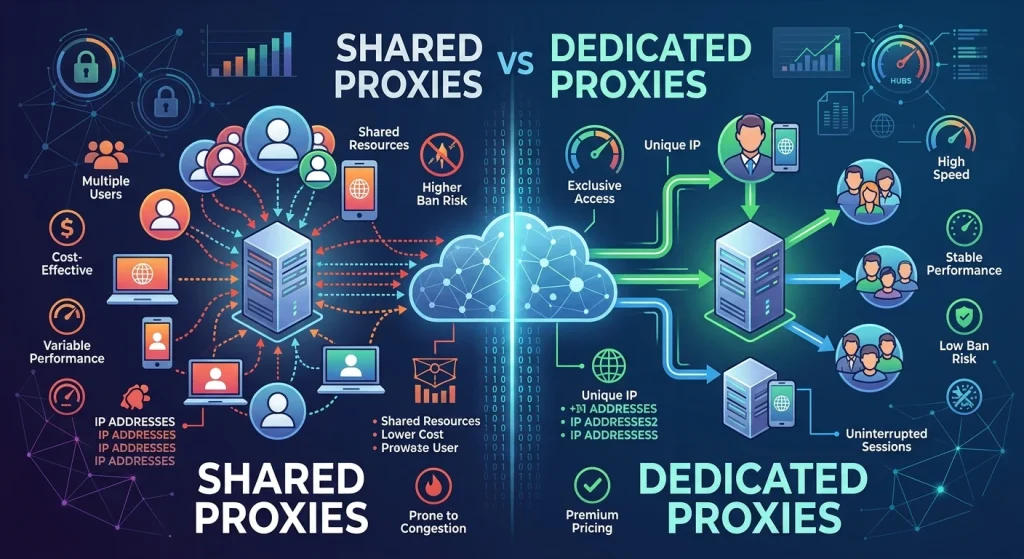
| Performance Pillar | Shared Proxies | Dedicated Proxies |
| Exclusivity Matrix | Multi-user pooled access | 100% single-user ownership |
| IP Reputation Risk | High (vulnerable to neighboring spam) | Low (completely controlled by you) |
| Bandwidth & Speed | Variable (throttled by concurrent users) | Maximum throughput (fast dedicated proxies) |
| Target Stability | High CAPTCHA and block risk on strict sites | Stable sessions with minimal disruptions |
| Cost Efficiency | Minimal investment required | Premium pricing based on asset reservation |
1. Bandwidth Distribution and Speed Efficiency
With a shared proxy, the hosting server’s port speed (e.g., 1 Gbps) is divided dynamically among all active users. If a “neighbor” runs a heavy data extraction script, your connection may experience latency spikes and broken sockets. Conversely, dedicated proxy servers provide an unthrottled pipe, ensuring consistent, high-speed data transmission.
2. IP Reputation Control
Web application firewalls track request volume and behavior patterns per IP. If five users use the same shared datacenter proxy to query the same e-commerce platform, the target platform’s security will quickly spot the high request volume and issue a blanket block. Dedicated IPs maintain clean, predictable user footprints that mimic organic human browsing.
3. SOCKS5 and Protocol Flexibility
Enterprise proxy workflows often require advanced network protocols. High-tier dedicated socks5 proxies handle both TCP and UDP traffic, making them ideal for video scraping and complex web applications. Many shared networks restrict configurations to basic HTTP/HTTPS to prevent cross-user server crashes.
Deeper Insight: Network Configurations and Operating System Rules
What Does “Allow Proxies for Shared Networks” Mean?
When setting up corporate networks or adjusting operating system profiles (such as on a Chromebook or via Google Chrome), you will often see the option to allow proxies for shared networks.
This setting tells your operating system’s network configuration file to pass data from all local user profiles through a designated proxy path. If this option is allow proxies for shared networks greyed out, it usually means your company’s network administrator has locked the setting via an enterprise management console to enforce compliance.
Network Checklist: If you are unsure whether to enable this setting, check these three factors:
- Administrative Access: Do you have the required permissions to modify the system’s core registry?
- Local Security Policies: Does your corporate policy allow shared data routing across local users?
- Data Isolation: Are you comfortable with other local profiles using the same proxy credentials?
How to Match the Right Proxy Type to Your Workflow
Choosing between shared proxies vs dedicated proxies depends on your target platform’s security and the scale of your project.
When Are Shared Proxies the Best Option?
- Low-Security Public Data Collection: Excellent for scraping public sites that do not use advanced anti-bot defenses like Cloudflare or Akamai.
- Basic Price Monitoring: Good for running distributed checks across non-protected e-commerce sites where occasional latency won’t break your scripts.
- High-Volume URL Analysis: Useful for running broad broken-link checks across thousands of independent domains where speed variations are acceptable.
When Are Dedicated Proxies Essential?
- E-Commerce Storefront Management: Managing merchant accounts on platforms like Amazon or eBay requires a consistent, unbanned static IP footprint. A sudden IP change or shared block can cause immediate account restrictions.
- Automated SEO Monitoring and Rank Tracking: Running high-frequency keyword checks across multiple search engines requires dedicated seo proxies to prevent continuous CAPTCHA blocks.
- Social Media Management: Running client profiles on platforms like Instagram, TikTok, or Pinterest requires stable, dedicated connections. Shared addresses often lead to immediate profile verification locks.
Cross-Industry Workflows: Everyday Proxy Connections
Proxy setups show up in many different software tools, hardware configurations, and business environments. Here is a quick look at how different industries interact with proxy architectures.
Creative and Automation Workflows
- Video Editing Software (Filmora): Digital creators often search ¿es recomendable prender los proxy en Filmora Wondershare? (Is it recommended to turn on proxies in Filmora?). This actually refers to video editing proxies—low-resolution video files used to speed up timeline rendering—which are completely separate from network IP proxies.
- Shared Marketing Accounts: Digital agencies looking for ways to how to share Canva Pro accounts with proxy or how to share Hootsuite accounts with a proxy can use a dedicated static IP. This allows a remote team to access a single account from different locations without triggering security blocks for suspicious login locations.
- AI Research Automation: Teams researching how to share Perplexity accounts with proxy use dedicated IPs to run parallel automated research requests without triggering anti-bot rate limits.
Hardware and Network Routing
- Wi-Fi Connection Sharing: IT administrators frequently configure how to share a proxy connection over Wi-Fi or how to share proxy internet connection over Wi-Fi on Windows 10. This configuration turns a local device into a gateway, routing all connected Wi-Fi traffic through a secure proxy connection.
- Mobile Hotspot Configurations: Development teams working on mobile data collection use setups like how Android shared proxy hotspots pass traffic from a laptop through a phone’s dedicated mobile IP line to test mobile-specific app layouts.
Corporate Law and Web Infrastructure
- Financial Auditing and Corporate Records: If you are searching for where to find shares outstanding on a proxy statement or how to read a proxy card for shares, you are dealing with corporate governance law. In this context, a “proxy” refers to a legal document that gives an individual the right to cast a shareholder vote (proxy voting power of attorney stock shares).
- Shared Hosting Environments: Web developers often ask can I add a proxy to my shared hosting or how to add a proxy to shared hosting. If a shared server’s outbound IP is blacklisted, developers can route outbound traffic through a clean proxy IP to ensure automated transactional emails actually reach users’ inboxes.
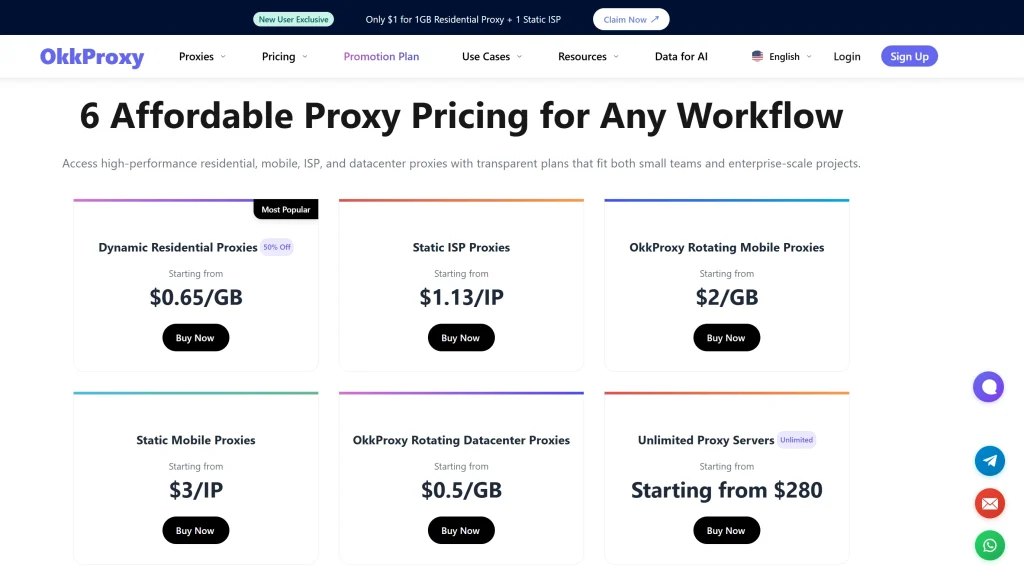
OKKProxy’s Product Solutions: Built for Enterprise Performance
At OKKProxy, we build high-performance data routing infrastructures designed to solve real-world web scraping and account management challenges. Our product suite covers both shared and dedicated architectures to match your exact business needs.
1. Rotating Residential Proxies
Our premium network includes over 150 million ethically sourced, real consumer IPs across more than 190 countries. By using rotating residential proxies, each data collection request looks like a genuine connection from a local home user. The network rotates IPs automatically based on your timing configurations or on every request, making it the perfect choice for large-scale web scraping projects. Read more about how these setups protect your data pipelines in our guide to improving web scraping success rates.
2. Static ISP Proxies
When your workflows need the fast download speeds of a datacenter line combined with the high reputation of a residential address, OKKProxy’s static ISP proxies offer the ideal hybrid solution. These dedicated residential IPs are hosted directly on major Internet Service Provider networks. They remain assigned exclusively to you for as long as you need them, providing a stable footprint for managing e-commerce accounts or running localized ad verification campaigns. Explore our detailed breakdown on 5 reasons why static isp proxies are the secret weapon for professional resellers.
3. Rotating & Static Mobile Proxies
To bypass the web’s strictest anti-bot systems, our rotating mobile proxies and static mobile proxies route your data through real 4G and 5G cellular carrier networks. Mobile IPs are highly resilient against bans because major websites avoid blocking them to prevent blocking real mobile users who share those carrier networks.
4. Rotating Datacenter Proxies
For high-volume data mining on websites with basic security protocols, our rotating datacenter proxies offer excellent performance at an affordable price point. They deliver high-speed bandwidth and quick rotation options, allowing you to maximize data processing speeds while keeping operational costs low.
Real-World Cases and Industry Insights
Case Study 1: Solving the “Bad Neighbor” Issue in E-Commerce Scraping
- The Problem: A market intelligence firm was using a cheap shared datacenter proxy pool to monitor competitor pricing on Amazon. Because other users in the shared pool were scraping aggressively, the IPs faced constant blocks, leading to a high 42% request failure rate and endless CAPTCHAs.
- The OKKProxy Solution: We migrated their data pipeline over to our dedicated static ISP proxies.
- The Outcome: By eliminating shared IP noise, their data extraction success rate rose to 99.4%, while overall scraping times dropped by more than half.
Case Study 2: Protecting Social Media Assets for Marketing Agencies
- The Problem: A digital marketing agency was managing 15 client Instagram profiles from a single office. Using standard office internet or a basic shared proxy server caused repeated login verifications and automated account shadowbans.
- The OKKProxy Solution: We assigned a dedicated static mobile proxy to each individual account manager’s workflow.
- The Outcome: By matching clean, dedicated mobile connection signatures, the agency completely eliminated suspicious login triggers and kept their clients’ digital assets secure.
Deployment Checklist: Choosing Your Ideal Proxy Set
Before launching your data collection project, use this checklist to confirm which proxy type aligns best with your application requirements:
- Analyze Target Security Strength: Does the target site use advanced anti-bot defenses like Cloudflare, Akamai, or PerimeterX?
- Yes: Choose Dedicated ISP Proxies or Mobile Proxies.
- No: Proceed with Shared Datacenter Proxies.
- Determine Session Longevity Requirements: Do your scripts need to maintain a single session connection for more than 10 minutes (e.g., filling out multi-step forms or managing user accounts)?
- Yes: Deploy Static ISP Proxies.
- No: Use Rotating Residential Proxies.
- Calculate Budget Scale vs. Performance Costs: Is cost minimization your primary target over data delivery speed?
- Yes: Leverage a high-quality shared proxy buy option.
- No: Invest in a dedicated private proxy setup to protect your data pipeline.
Frequently Asked Questions (FAQ)
What are the three types of proxies?
The three primary proxy types are Datacenter proxies (hosted in cloud data servers, offering high speed at low cost), Residential proxies (real residential devices assigned by ISPs, providing high anonymity), and Mobile proxies (real 3G/4G/5G mobile network connections, offering the highest resilience against IP bans).
What does “shared proxy” mean?
A shared proxy means that the single IP address routing your traffic is simultaneously being used by other clients of the proxy provider. This lowers service costs but introduces performance sharing and potential “bad neighbor” IP bans.
What is the difference between shared and dedicated IP addresses?
A shared IP address handles web traffic for multiple unrelated clients at the same time, which can lead to shared bans and variable connection speeds. A dedicated IP address is assigned exclusively to one single user, ensuring complete control over speed, data security, and IP reputation.
Should I choose semi-dedicated or dedicated proxies?
Semi-dedicated proxies are typically shared among a small, fixed number of users (usually 3 to 5). While they are cheaper than fully dedicated proxies, they still carry a mild risk of cross-user bans. Fully dedicated proxies give you 100% exclusive access, making them the safest option for critical business applications.
Will shared proxies work for social media automation?
Generally, no. Modern social media networks utilize advanced user footprint tracking. Using a shared proxy often exposes your accounts to shared bans from other users’ bad behavior. For reliable account growth and management, utilizing dedicated mobile or static ISP proxies is highly recommended.
Conclusion: Making the Right Strategic Investment for Your Business
Choosing between shared proxies vs dedicated proxies is not a matter of finding the absolute “best” tool, but rather about selecting the architecture that matches your project’s risk tolerance, platform complexity, and operational scale.
- Shared proxies offer an excellent, highly economical starting point for broad market research, budget-conscious web scraping, and low-stakes automated testing on websites with light security protocols.
- Dedicated proxies, on the other hand, provide the foundational security, elite speeds, and clean IP reputations required to protect business-critical assets. For digital marketers managing high-value merchant storefronts, SEO professionals tracking exact localized SERPs, and data analysts extracting web data at scale from strict domains, the isolation of dedicated infrastructure is essential.
By choosing an enterprise proxy infrastructure partner like OKKProxy, you can stop worrying about frequent IP bans, inaccurate data tracking, and restricted geographic targeting. Our comprehensive fleet of automatic rotating residential proxies, high-speed static ISP proxies, and highly resilient mobile proxies ensures your automated workflows run consistently, smoothly, and securely.