Summary
When building or deploying autonomous AI agents, performance hinges on one critical factor: access to real-time web data. Modern artificial intelligence applications no longer rely solely on static training datasets. From AI-driven SEO rank tracking and automated market intelligence to competitive price monitoring and ad verification, smart agents need continuous, sub-second access to the live web.
However, gathering live intelligence presents a major technical hurdle. Web platforms deploy increasingly sophisticated anti-bot defenses, dynamic rate limits, CAPTCHAs, and geo-fencing barriers. If your automated AI workflows send repeated requests from a single IP address or an unverified cloud server, your data pipeline quickly grinds to a halt due to IP bans and blocklists.
To bypass these hurdles, engineering leads, data analysts, and digital marketers generally choose between two primary architectural paths: building custom web scraping pipelines powered by proxies or consuming data via third-party Web APIs.
In this comprehensive guide, we will break down how AI agents harvest live intelligence, compare the cost and control of proxies versus Web APIs, and explore how high-quality proxy networks—such as OkkProxy’s rotating residential and static ISP proxies—deliver unblockable, scalable, and cost-effective data pipelines.
What Is Real-Time Web Data and Why Do AI Agents Need It?
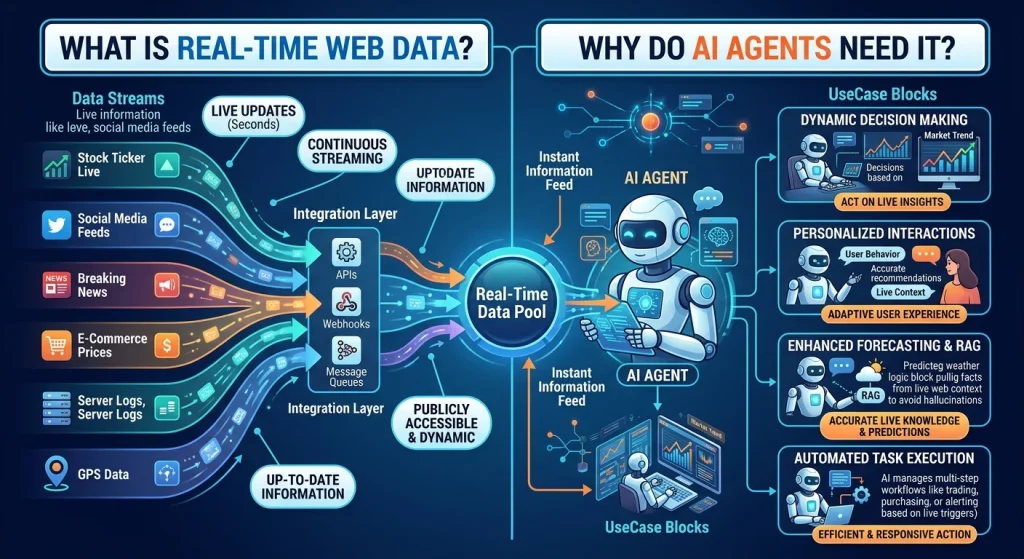
Real-time web data refers to live, up-to-second information collected directly from public websites, online marketplaces, search engine results pages (SERPs), social networks, and financial portals. Unlike static historical databases, live web information provides immediate operational value.
Autonomous AI web agents rely on live web streams to execute four core operational functions:
- Retrieval-Augmented Generation (RAG): Grounding Large Language Model (LLM) responses in real-time web facts to eliminate hallucinations and provide up-to-date answers.
- Dynamic Price Monitoring: Extracting instant pricing variations across global e-commerce platforms to optimize automated repricing strategies.
- SEO Rank & SERP Tracking: Scraper engines pulling localized search engine results to track keyword rankings across multiple cities and regions.
- Ad Verification and Fraud Detection: Inspecting digital ad placements across worldwide ad networks to verify compliance and detect click fraud.
Core Architectural Comparison: Proxies vs. Web APIs
When establishing a pipeline for real-time web data extraction, teams face a foundational build-versus-buy decision: Should you route custom browser automation through clean proxy networks or purchase ready-to-use data through Web APIs?
The table below highlights the operational differences between these two approaches:
| Feature | Proxy Infrastructure (Build Path) | Web API Middleware (Buy Path) |
| Data Output Format | Raw HTML, DOM trees, JSON-LD, or rendered JS state (100% customizable) | Pre-parsed Markdown, simplified JSON, or vector embeddings |
| IP Pool & Session Control | Granular control over IP types (Rotating Residential, Static ISP, Mobile Proxies) | Opaque vendor infrastructure; zero control over exit nodes |
| Anti-Bot Defense | Custom browser fingerprints, custom headers, and automated rotation | Handled implicitly by the API vendor |
| Cost at Enterprise Scale | Charged per GB consumed (Highly cost-effective for large data volumes) | Charged per request or subscription tier (Includes vendor markup) |
| Data Provenance & Audit | Direct access to raw source HTML; zero risk of parser filtering | Risk of vendor parser hallucinations or data omissions |
| Pipeline Flexibility | High (Adaptable to login walls, complex scripts, and user flows) | Low (Dependent on vendor API support for target sites) |
Route 1: The Proxy Architecture (Building Scalable Data Pipelines)
For data-driven teams, digital marketers, and enterprise scraping operations requiring total autonomy, routing custom scraping tools through specialized proxies remains the gold standard for gathering real-time web data.
In this architecture, your AI agent uses headless browser automation frameworks (such as Playwright, Selenium, or Puppeteer) or high-speed asynchronous HTTP libraries. Rather than connecting directly to target websites, the agent routes its web requests through a pool of proxy servers.
How Proxies Prevent IP Bans and Mask Agent Footprints
Anti-bot systems like Cloudflare, Akamai, and DataDome analyze incoming traffic using IP reputation scores, browser fingerprints, and request rates. When an automated tool sends hundreds of requests from a single datacenter IP, the target server immediately blocks the address or issues CAPTCHA challenges.
Proxies solve this challenge by replacing your agent’s origin IP with clean, legitimate IP addresses distributed across global locations. Depending on your project requirements, matching the right proxy type to your workload is essential:
- Rotating Residential Proxies: Sourced from genuine residential internet connections across 190+ countries. By automatically rotating the IP address on every request or maintaining sticky sessions for up to 60 minutes, rotating residential proxies allow AI agents to gather localized search results and price feeds without triggering rate limits.
- Static ISP Proxies: Built using real residential ASN ranges hosted directly on high-speed data center servers. Static ISP proxies deliver the non-blockable trust scores of residential IPs alongside sub-10ms latency and 99.9% uptime—making them ideal for account management, long-lived sessions, and multi-step web navigation.
- Rotating Mobile Proxies & Static Mobile Proxies: Leveraging genuine 4G/5G cellular carrier networks (AT&T, Verizon, Vodafone). Because mobile IPs utilize Carrier-Grade NAT (CGNAT) shared among thousands of mobile devices, target websites rarely block them without risking major collateral damage.
- Rotating Datacenter Proxies: High-speed, budget-friendly options designed for unprotected public sites, open directories, and massive datasets where rapid execution speed is paramount.
Route 2: The Web API Architecture (Consuming Pre-Parsed Data)
The alternative architectural path relies on third-party Web APIs or specialized web-to-LLM gateways. Instead of managing browser automation, your AI agent sends a structured API request (usually containing a target URL) to an intermediate vendor. The vendor handles connection routing, JavaScript rendering, and anti-bot bypasses, returning clean Markdown or JSON directly to your AI agent.
The Trade-Off: Development Speed vs. Long-Term Costs
While Web APIs simplify initial prototyping by removing the need to manage HTML parsing logic, operational costs escalate rapidly at enterprise scale.
For teams processing high page volumes (over 200,000 requests per month), third-party API request markups become prohibitive. Managing your own scraper pipeline via OkkProxy allows you to pay purely for bandwidth consumed, yielding savings of up to 70% to 80% on infrastructure costs while maintaining 100% control over your raw DOM data.
Real-World Case Study: Automated SEO Rank Tracking at Scale
To understand how high-quality proxy infrastructure impacts enterprise performance, consider the experience of a global digital marketing agency specializing in multi-region SEO monitoring.
Client Case Study: E-Commerce SEO Rank Tracking
The Challenge: An international SEO agency monitored local Google SERPs across 85 geographic regions for a major e-commerce client. Their in-house AI agents frequently encountered CAPTCHA blocks, resulting in missing data, inaccurate localized ranking reports, and high task failure rates.
The Solution: The agency transitioned its automated scraping pipeline to OkkProxy’s Rotating Residential Proxies combined with targeted Static ISP Proxies. By setting sticky residential sessions pinned to specific postal codes, their AI agents simulated natural search sessions across every target city.
The Results:
- 99.8% Request Success Rate: Eliminated IP bans and CAPTCHA blockages across all target regions.
- 100% Geo-Accuracy: Captured precise local rank tracking data without search engine fallback default locations.
- 65% Cost Reduction: Reduced infrastructure spend compared to their previous managed scraping API provider.
5 Powerful Proxy Strategies to Scale Real-Time Web Data Extraction
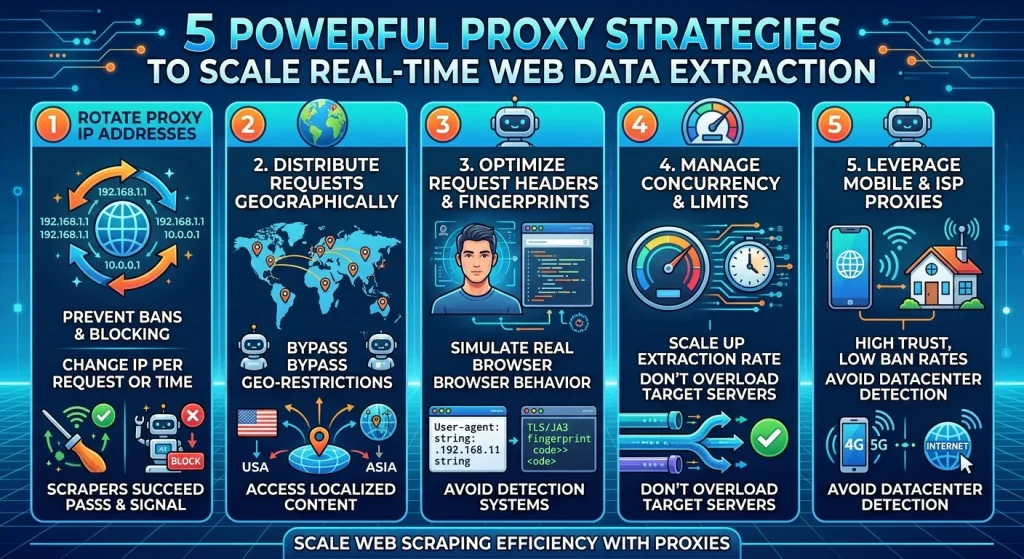
To build a reliable, unblockable data engine for your AI web agents, follow these five field-tested proxy management strategies:
1. Implement Intelligent IP Pool Rotation
Avoid sending consecutive requests to the same domain from a single IP. Utilize OkkProxy’s dynamic rotation settings to switch IP addresses automatically per request for large-scale crawling, or maintain sticky sessions (5 to 30 minutes) for tasks requiring user logins or shopping cart interactions.
2. Match IP Types to Site Anti-Bot Strictness
Save budget and optimize speed by tailoring your proxy selection to the target domain’s security level:
- Use Datacenter Proxies for simple, low-security public web pages.
- Use Rotating Residential Proxies for e-commerce sites, SERPs, and social media platforms monitored by Cloudflare or Akamai.
- Use Static ISP or Mobile Proxies for high-value account management, financial portals, and sensitive verification tasks.
3. Customize Request Headers and TLS Fingerprints
Modern anti-bot systems analyze HTTP request headers and TLS handshakes. Ensure your AI agents rotate User-Agent strings matching real web browsers, supply appropriate Accept-Language headers corresponding to your proxy’s geo-location, and use patched HTTP clients (like curl_cffi or Playwright Stealth) to align TLS/JA3 fingerprints.
4. Manage Request Pacing and Concurrency Limits
Even with clean residential proxies, sending thousands of concurrent requests to a single hostname from a small IP range can trigger rate limits. Implement exponential backoff retry logic and distribute traffic across a broad pool of clean IP addresses.
5. Leverage Geo-Targeting for Contextual Accuracy
Content, pricing, and rankings vary significantly by location. OkkProxy allows you to route requests down to specific countries, states, and cities, ensuring your AI agents pull the exact localized data visible to target human audiences.
Decision Checklist: Which Option Is Right for Your Project?
Use this practical decision checklist to determine whether custom proxy pipelines or Web APIs best suit your current project requirements:
- Choose OkkProxy-Backed Pipelines if:
You extract large data volumes (over 200,000 pages per month) and need to optimize bandwidth costs.
You require full control over raw HTML, shadow DOMs, or full JavaScript states.
You manage account logins, session persistence, or multi-step checkout flows.
You need precise city-level or carrier-level IP targeting.
You require complete data auditability without third-party LLM pre-filtering.
- Choose Web APIs if:
You are building an early-stage prototype or proof-of-concept.
You need instant structured Markdown outputs without writing DOM parsing scripts.
Your total monthly request volume is low (under 50,000 requests per month), making developer time more expensive than API markups.
Frequently Asked Questions (FAQ)
What is the best web scraping proxy strategy for gathering real-time web data?
The most effective strategy combines rotating residential proxies for broad web scraping and search engine extraction with static ISP proxies for tasks requiring session continuity or login maintenance. This combination ensures high trust scores, low ban rates, and reliable performance.
How do AI agents access real-time web data safely without getting blocked?
AI agents access live web data safely by routing requests through clean, ethically sourced residential proxy pools, mimicking human browsing behavior, honoring target server rate limits, and using realistic browser headers and TLS fingerprints.
Why are residential proxies better than datacenter proxies for AI web scrapers?
Datacenter proxy IPs originate from commercial cloud providers (like AWS or DigitalOcean), which are easily recognized and blocked by major anti-bot platforms. Residential proxies use real residential IP addresses assigned by consumer ISPs, making traffic appear identical to organic human visitors.
What is the difference between static ISP proxies and rotating residential proxies?
Static ISP proxies provide fixed, permanent IP addresses hosted on datacenter infrastructure with residential trust scores, offering ultra-low latency and stable sessions. Rotating residential proxies automatically change IP addresses per request or time interval, providing maximum anonymity across millions of requests.
Key Takeaways
Reliable access to real-time web data is essential for building competitive, high-performing AI web agents and automated monitoring tools. While third-party Web APIs offer quick setup for small projects, building custom scraping pipelines backed by robust proxy networks delivers unmatched cost savings, data accuracy, and operational control at scale.
By partnering with OkkProxy, your team gains instant access to a global network of over 80 million ethically sourced IPs—including rotating residential proxies, static ISP proxies, rotating mobile proxies, static mobile proxies, and high-speed datacenter proxies.
Ready to scale your web scraping operations and fuel your AI models with clean, real-time intelligence? Explore OkkProxy today to discover high-performance proxy solutions built for modern enterprise demands.