Summary:
This ultimate guide explores the distinct architecture of mobile vs residential proxies, highlighting their unique trust profiles, technical differences (such as CGNAT deployment vs. standard broadband lines), and practical applications. Discover how balancing rotating residential networks with premium mobile gateways through OKKProxy can optimize your data collection pipelines, maximize task success rates, and drastically reduce infrastructure costs.
Introduction: Navigating the Complexities of Proxy Infrastructure
In the highly competitive world of digital marketing, data analysis, and search engine optimization, access to accurate and continuous web data is essential. Modern websites protect their assets using advanced anti-bot frameworks, behavioral analysis, and security algorithms. For teams managing automated tools for web scraping, ad verification, or multi-region account management, experiencing a sudden block or being presented with endless captchas can bring critical operations to a complete standstill.
To overcome these roadblocks, choosing a robust IP infrastructure is paramount. When auditing your data collection strategies, evaluating the unique strengths of mobile vs residential proxies is a crucial step toward ensuring long-term task stability.
Both residential and mobile options represent a massive step up from traditional hosting provider networks because they utilize genuine internet service provider (ISP) registries. However, they are built on completely different physical infrastructures, navigate distinct network paths, and offer separate levels of authority to target platforms. Understanding residential vs mobile proxies requires looking under the hood at how internet providers assign network addresses and how web servers interpret those incoming signals.
Deploying an incompatible proxy type can lead to immediate connection drops, inaccurate data extraction, or lost marketing assets. OKKProxy provides a comprehensive fleet of high-performance tools—including rotating residential proxies, static ISP proxies, rotating mobile proxies, static mobile proxies, and rotating datacenter proxies—to cover every aspect of your business automation. This complete guide cuts through the noise to help you select the ideal setup for your business workflows. To review broader internet networking blueprints, consider exploring the authoritative standards on the World Wide Web Consortium (W3C).
What are the Main Types of Proxies in Use Today?
Before diving deep into a mobile proxy vs residential proxy analysis, it is useful to establish a baseline of the broader proxy ecosystem. Enterprise systems generally divide proxy setups into three separate functional tiers:
- Datacenter Proxies: These IPs are hosted in remote cloud servers and corporate data facilities. They provide exceptional speeds, high performance, and affordable pricing structures. However, because their subnet footprints are publicly tied to hosting companies rather than individual home users, advanced platforms flag and block them quickly. For straightforward scraping tasks on targets with lighter defenses, organizations turn to OKKProxy’s reliable rotating datacenter proxies.
- Residential Proxies: These connections belong to standard household landlines and consumer broadband plans. Because they are assigned by consumer ISPs, destination websites see them as genuine people browsing from home, balancing deep geographic coverage with solid trust scores.
- Mobile Proxies: These networks utilize active mobile data plans (3G, 4G, LTE, and 5G) assigned by cellular network carriers. Mobile connections interface directly through neighborhood cell towers, which grants them the highest level of trust and authority available in the industry.
Core Takeaway: Datacenter proxies prioritize raw processing speed and low costs; residential proxies provide deep geographic targeting at a highly scalable price point; mobile proxies offer unparalleled security and resistance to bans at a premium investment level.
What is a Residential Proxy vs Mobile Proxy?
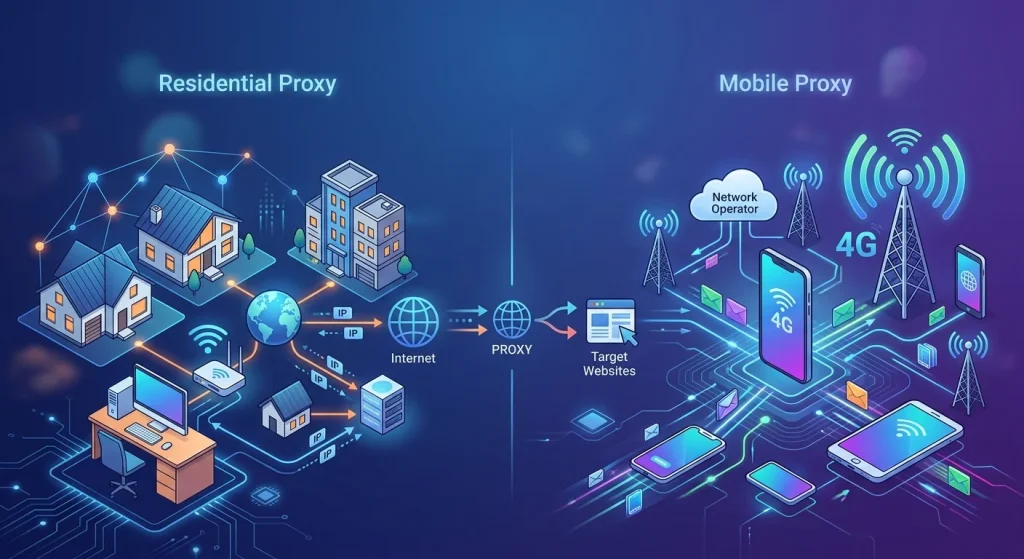
To truly appreciate the performance differences between residential and mobile proxies, we must evaluate how they present themselves to target servers. Modern security systems query IP intelligence databases to inspect inbound web requests, looking closely at the network type classification and Autonomous System Number (ASN). Comparing a residential proxy vs mobile proxy deployment reveals a clear distinction in how these signatures are handled.
Residential Proxies: Fixed Home Networks
Residential proxies route your traffic through an intermediary household device connected to local consumer broadband (such as Comcast, Spectrum, or Virgin Media). When utilizing OKKProxy’s rotating residential proxies, your scraping scripts mirror real consumers browsing the web from their living rooms. The destination platform reads the residential ASN signature, matches it to a standard home connection, and allows the request to pass smoothly.
For long-term operations that require a permanent, unbroken digital identity, OKKProxy offers premium static ISP proxies. These tools bridge the gap by combining the speed and uptime of a data center backbone with the trusted ASN status of a legitimate residential internet provider, eliminating mid-session rotation risks.
Mobile Proxies: Cellular Network Nodes
Mobile proxies use an entirely different network structure. Instead of linking to a permanent landline, your automated request travels over a cellular carrier network (like Verizon, T-Mobile, or Vodafone) to reach the web. This cellular routing alters how security filters perceive your connection, granting mobile endpoints an exceptionally high level of authority. Understanding the fundamental differences between residential and mobile proxies helps your technical teams protect valuable accounts while avoiding unnecessary infrastructure overhead.
Complete Mobile Proxies vs Residential Proxies Comparison
The differences between residential and mobile proxies cover multiple essential categories, such as geographic accuracy, connection stability, rotation settings, and price. Reviewing a direct mobile proxies vs residential proxies comparison table allows your engineering team to align their automation scripts with the best network type.
| Feature Matrix | Mobile Proxies (3G/4G/5G Cellular Networks) | Residential Proxies (Home Broadband Lines) |
| IP Allocation Source | Mobile carriers (AT&T, T-Mobile, Orange) | Fixed landline ISPs (Comcast, CenturyLink) |
| Anonymity & Trust Level | Highest available (Highly resistant to blocks) | Excellent (Looks like natural consumer traffic) |
| Rotation Flexibility | Dynamic (Changes with tower handovers) | Highly customizable (Sticky sessions or instant) |
| Connection Stability | Dependent on cell signal & tower switching | Exceptionally stable (Fixed fiber/cable) |
| Geo-Targeting Depth | Country, Region, and Mobile Carrier level | Ultra-granular (Country, State, City, Zip Code) |
| Pricing Models | Billed per active port or premium allocations | Billed per Gigabyte (GB) with open pool access |
| Security Footprint | Masked by Carrier-Grade NAT (CGNAT) | Associated with individual household locations |
Why Do Mobile Proxies Have a Higher Trust Score Than Residential Proxies?
When analyzing network trust levels, mobile architectures outperform residential networks due to a widespread telecom protocol known as Carrier-Grade NAT (CGNAT).
In standard home broadband systems, an ISP assigns a distinct public IPv4 address to each subscriber’s household. If an automated script operating on a residential IP sends an aggressive number of requests to a website, the platform’s firewall can block that specific IP without affecting neighboring homes. The risk of blocking innocent users is minimal.
Cellular networks face a different challenge: they support millions of connected mobile devices but have a limited pool of available public IPv4 addresses. To solve this, cellular providers deploy CGNAT. Under this architecture, a single public mobile IP address is shared simultaneously by hundreds or thousands of real mobile users connected to the same cell tower. As people walk through a city, check their social accounts, or shop online, they leave an identical public network footprint.
This creates a major strategic advantage for proxy users. If a target platform blocks a single mobile proxy IP, it risks accidentally locking out hundreds of genuine, paying human customers who happen to share that same CGNAT address. To avoid causing widespread false positives, websites rarely implement harsh, sweeping bans on mobile carrier IPs. Instead, they apply milder security challenges, making mobile connections highly effective for navigating strict web filters.
OKKProxy Operational Snapshot: E-Commerce Scale
An online agency came to OKKProxy after experiencing high failure rates while managing over 150 e-commerce profiles via traditional residential networks. When automation scripts triggered strict anti-bot filters, the specific residential IPs faced instant bans, putting multiple accounts at risk.
Our engineers moved their core sessions over to OKKProxy’s rotating mobile proxies alongside dedicated static mobile proxies for account maintenance. Because target platforms recognized the incoming traffic as part of a shared carrier network protected by CGNAT, the automated actions proceeded without friction. Account block rates dropped to zero, protecting the client’s business continuity.
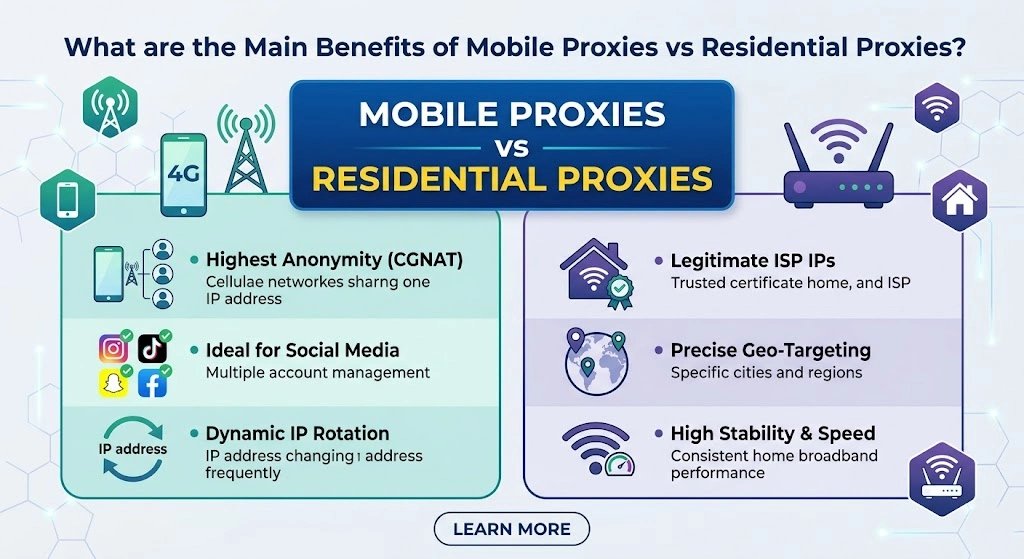
What are the Main Benefits of Mobile Proxies vs Residential Proxies?
While mobile proxies offer incredible trust advantages, residential networks remain vital for scaling broad enterprise data projects. Deciding when to buy residential and mobile proxies requires examining the distinct business benefits each option provides. To secure the best residential and mobile proxies, most digital teams utilize a combined approach.
Top benefits of mobile proxies vs residential proxies:
- Immunity to Bulk Bans: Thanks to CGNAT protocols, mobile networks are structurally shielded from permanent, blanket blacklisting by major web platforms.
- Flawless Mobile Footprints: Mobile proxies align with mobile device headers, making them perfect for platforms that optimize specifically for smartphone app users.
- Natural Carrier Rotation: Connections shift seamlessly across cellular bands, providing organic rotation patterns that accurately mimic a human traveling on a mobile network.
Top Benefits of Residential Proxies:
- Hyper-Targeted Location Settings: Residential networks provide vast IP pools that span thousands of specific cities and postal codes worldwide, making them essential for hyper-local ad verification and rank tracking.
- Unmatched Connection Stability: Fixed home broadband connections do not suffer from cellular signal fading or tower handovers, allowing for continuous, long-running data extractions.
- Highly Cost-Effective Scaling: Billed based on data usage with no per-port limitations, residential setups make large-scale web scraping highly economical.
Real-World Use Scenarios: Aligning Proxy Choice to Your Project
To maximize the return on your proxy infrastructure investment, you must match the technical profile of your proxy type with your specific business tasks. Launching an automated campaign without considering target defense mechanisms can quickly inflate data collection expenses. Understanding where to deploy mobile vs residential proxies saves technical teams valuable troubleshooting time.
When to Choose Mobile Proxies
- Social Media Automation (Instagram, TikTok, LinkedIn): Social networks deploy advanced device fingerprinting and behavioral analysis. Operating accounts via low-quality connections triggers instant verification loops. Utilizing rotating mobile proxies ensures your accounts remain safe within normal telecom carrier networks.
- Mobile Application Scraping: Modern mobile apps route requests through specialized API endpoints optimized for mobile data networks. Gathering this data requires mobile proxies to ensure compatibility with mobile network patterns.
- Ad Verification and Anti-Fraud Auditing: To detect and eliminate ad fraud, companies must verify redirects from genuine cellular perspectives. Mobile proxies allow you to view ad delivery exactly as it appears to mobile users on real networks.
When to Choose Residential Proxies
- High-Volume Web Scraping & E-Commerce Extraction: Extracting data from large marketplaces requires millions of unique IP addresses to bypass automated rate limits. OKKProxy’s expansive global pool of rotating residential proxies provides the scale needed to run high-volume extractions securely and affordably.
- Localized SEO Auditing & Rank Tracking: Search engine results change based on a user’s exact city or zip code. Residential proxies enable SEO agencies to monitor hyper-localized search result pages across multiple regions simultaneously.
- Retail Price Intelligence: Consumer brands alter pricing based on regional demand and buyer demographics. Residential endpoints allow you to monitor localized pricing changes without triggering anti-scraping defenses.
Are Mobile Proxies Better or Worse than Residential Proxies?
The ideal answer depends completely on your project’s specific technical parameters, target defenses, and overall budget constraints. Neither network type is universally superior; they are engineered for entirely different production goals.
- Mobile proxies are better if your main priority is bypassing aggressive anti-bot defenses on strict platforms like Instagram, Google, or Ticketmaster, or when your automation scripts need to mimic smartphone app traffic. The trade-off involves higher bandwidth costs and broader city targeting.
- Residential proxies are better when your project requires massive data collection across thousands of highly specific geographic areas. They deliver excellent connection stability and scalable pricing, making them the standard choice for large-scale enterprise data operations.
Technical Deployment Checklist: Choosing Your IP Class
- Analyze Target Platform Defenses: Determine if the site uses simple rate-limiting or advanced behavioral defenses like Cloudflare or Akamai.
- Confirm Geographic Requirements: Decide whether you need broad country-level targeting or precise municipal city and zip code resolution.
- Review Data Volume & Budget: Estimate if your task requires high-volume multi-terabyte extraction or low-data, high-value session maintenance.
- Match Device Fingerprints: Ensure your automation setup aligns correctly (e.g., matching a mobile proxy with an Android/iOS browser footprint).
Answers to Frequently Asked Questions
Can I use residential proxies on a mobile device?
Yes, you can route smartphone or mobile emulator traffic through residential proxy networks. However, if a target website inspects the connection’s ASN, it will see a mobile device communicating over a home broadband line. While this occurs naturally when users connect to home Wi-Fi, using a mobile proxy on mobile devices provides a more consistent match for cellular-only application workflows.
Are residential proxies legal to use?
Yes, residential proxies are entirely legal. However, proxy networks must ensure ethical procurement by obtaining explicit, informed consent from participants within their peer-to-peer networks. OKKProxy ensures that all network endpoints are sourced through transparent, compliant networks that adhere strictly to international data privacy regulations like GDPR and CCPA.
Can a residential proxy be detected by websites?
While residential proxies use genuine consumer signatures, advanced web filters can flag them if they exhibit non-human behaviors. Making hundreds of simultaneous requests per second or failing browser validation checks will flag any connection. To prevent detection, pair high-quality residential IPs with natural human delays and accurate header configurations.
Global Market Insights: Regional Proxy Performance
Proxy performance and pricing dynamics often vary depending on the local telecommunications infrastructure of your target region. Let’s look at how market conditions shape proxy utility across key international areas:
Great Britain: High-Density Telecom Connectivity
The network environment across Great Britain features deep infrastructure coverage and highly consolidated telecom structures. When reviewing mobile residential proxies pricing and reviews in great britain, enterprise teams find that mobile networks deliver high data transfer rates and low latency. This makes the UK market ideal for fast social media automation and automated localized price intelligence tasks.
Japan: Advanced Carrier Security
Japan features unique internet provider environments and strict security frameworks managed by dominant regional carriers like NTT, SoftBank, and KDDI. Exploring mobile residential proxies pricing and reviews in japan highlights the premium nature of verified Japanese IPs. Because regional anti-fraud systems are highly sensitive to foreign traffic, accessing localized Japanese content requires premium, locally hosted residential or mobile proxies to ensure consistent success.
Conclusion: Building a Balanced Proxy Infrastructure
When deciding between mobile proxy vs residential proxy setups, the most successful enterprises avoid relying on a single network type. Instead, they deploy a balanced, hybrid strategy that utilizes the unique advantages of both proxy classes. Organizing your technical resources around the practical strengths of mobile vs residential proxies ensures maximum operational efficiency.
By pairing the massive scale and precise location targeting of rotating residential proxies with the exceptional trust and anti-ban capabilities of rotating mobile proxies, you create a highly resilient data collection framework. Partnering with a dedicated provider like OKKProxy gives your business instant access to a premium global pool built to handle web scraping and account management at scale.
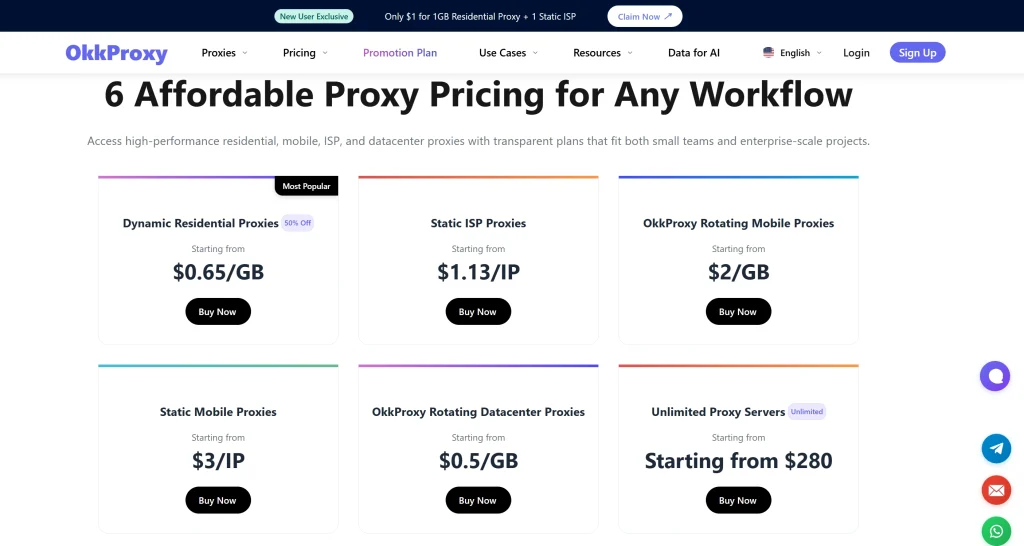
Ready to optimize your network performance and maximize your data success rates? Explore OKKProxy’s professional proxy suites today:
- Launch expansive web campaigns using our global Rotating Residential Proxies Solution.
- Maintain secure, long-term sessions with our enterprise-grade Static ISP Proxies Pool.
- Navigate strict anti-bot filters using our advanced Rotating Mobile Proxies Network.
- Secure permanent, trusted mobile identities via our Static Mobile Proxies Gateway.
- Optimize high-speed scraping tasks with our cost-efficient Rotating Datacenter Proxies Service.