Introduction: The Enterprise Proxy Pricing Conundrum
If you have ever scaled a complex web scraping operation, managed a multi-account social media ecosystem, or orchestrated global search engine result page (SERP) monitoring campaigns, you have likely run into an industry standard that seems counterintuitive at first: Why are residential proxies charged per GB? In a world where enterprise software-as-a-service (SaaS) applications, cloud hosting servers, and home internet connections are billed via flat, predictable monthly subscription models, the proxy market stands out with its usage-based structure. Why do top-tier residential proxies demand metered billing while traditional datacenter options let you run unmetered traffic for a fixed price?
The short answer is that when you purchase a high-performance residential proxy, you are not simply buying raw internet bandwidth. Instead, your business is paying for legal, compliant access to an incredibly scarce, dynamic resource: authentic human user identity, high-integrity residential IP reputation, global geographic diversity, and the intricate, high-availability routing architecture required to manage these nodes without workflow disruption. For digital marketers, data analysts, and SEO professionals operating in the awareness or consideration stage of data infrastructure design, understanding the economic and technical variables behind this pricing mechanism is the absolute key to optimizing data gathering architecture and protecting project profit margins.
The Structural Divergence: Datacenter Subnets vs. Residential Peer Hardware
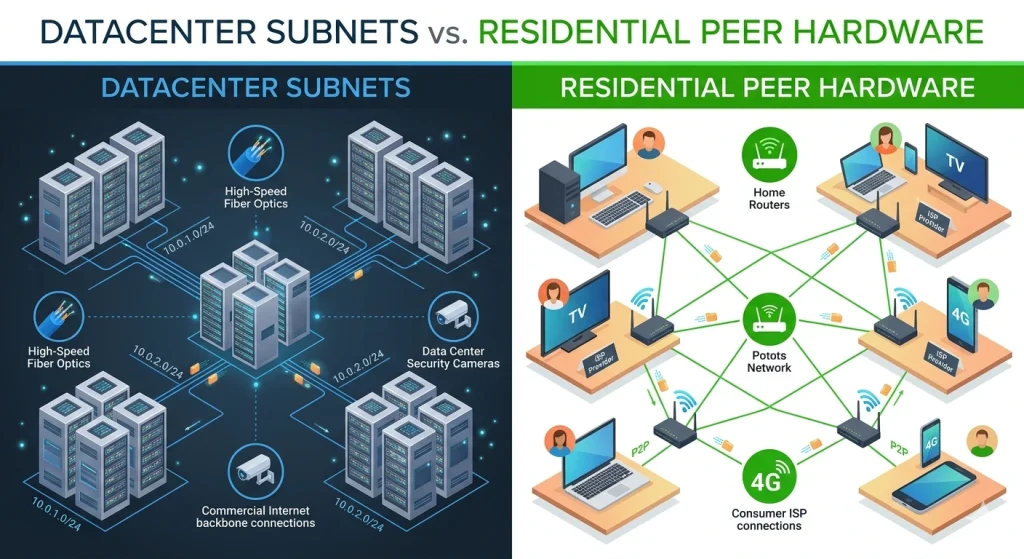
To grasp why the global market structured itself around metered bandwidth tracking, we must examine the radical infrastructure differences between dedicated hosting-provider networks and user-centric peer nodes.
1. Datacenter Proxies: Fixed Commercial Assets, Predictable Bandwidth
Datacenter proxies originate from centralized server farms and corporate cloud data centers (such as AWS, DigitalOcean, or Linode). Proxy providers rent physical server racks or block subnet ranges directly from these facilities. The cost profile of a datacenter subnet is entirely predictable: fixed monthly server rentals, abundant fiber-optic pipes, and contractual unmetered bandwidth allocations. Because the underlying operational cost does not fluctuate based on a few extra terabytes of data transfer, proxy companies pass this predictability down to the customer as flat monthly plans per IP address.
2. Residential Proxies: Dynamic, Human-Powered Consumer Networks
Conversely, a residential network consists of actual home internet connections supplied by local Internet Service Providers (ISPs) like Comcast, AT&T, or Vodafone. These IPs belong to real desktop computers, smart TVs, and IoT appliances sitting in living rooms worldwide. Providers cannot simply wire up a commercial server rack to buy residential subnets; they must source connections one by one through decentralized user applications. This fundamental infrastructure constraint creates the foundational answer to the common industry question: Why are residential proxy providers charging per GB?
| Infrastructure Feature | Datacenter Proxies | Residential Proxies |
| IP Origin Source | Cloud Infrastructure & Data Centers | Real Households / Consumer ISPs |
| Primary Pricing Unit | Flat rate per IP per month (Unmetered) | Metered billing per Gigabyte (GB) consumed |
| IP Trust Reputation | Moderate to Low (Easily flagged by CDN/WAF) | Elite / Pristine (Behaves like a true human) |
| IP Node Availability | Static (100% online uptime) | Dynamic (Nodes join and leave continuously) |
| Sourcing Cost Profile | Fixed monthly commercial hosting fees | Variable downstream compensation per GB |
Four Core Pillars Driving the Per-GB Billing Model
Why exactly does usage volume determine your ultimate cost structure? Let us dissect the four technical and financial pillars that dictate why the modern market relies heavily on metered tracking rather than unmetered flat rates.
1. Ethical Sourcing Protocols and Direct Peer Compensation
Ethical proxy providers cannot manufacture real consumer addresses out of thin air. To legally route enterprise data through a household in Tokyo, London, or New York, the provider must utilize a Peer-to-Peer (P2P) network. Real individuals opt into these global networks by installing specialized application software or software development kits (SDKs) embedded inside companion consumer utilities, such as free VPNs or diagnostic browser extensions.
In exchange for sharing their idle home bandwidth, these users receive tangible rewards: premium app features, ad-free digital experiences, or direct micro-cash compensation. Crucially, the peer applications track bandwidth metrics, and providers compensate these everyday internet users based on the exact quantity of data routed through their home hardware. Because the proxy provider’s underlying cost scales dynamically with every megabyte used, they must pass these operational sourcing fees directly to the enterprise customer via granular metered billing.
2. IP Trust Reputation as a High-Value Strategic Asset
In the domain of large-scale web data extraction, IP Reputation is the real product. Strict web application firewalls (WAFs) like Cloudflare, Akamai, or PerimeterX treat datacenter subnets with inherent suspicion due to their known association with commercial automation bots. A consumer node, however, possesses an elite trust score because its requests blend in seamlessly with everyday organic human traffic.
However, when a web scraper uses a residential node to blast thousands of search requests per minute at an e-commerce platform like Amazon, that IP’s reputation immediately drops. The target server will trigger aggressive CAPTCHAs or block the node entirely. If a single user were allowed unmetered access under a flat monthly plan, they could burn through tens of thousands of premium residential nodes in a matter of hours, ruining the pool’s health for the rest of the ecosystem. By charging per GB, providers discourage brute-force, high-velocity target abuse and ensure that clients optimize their scraping scripts for clean, humanlike efficiency.
3. Complex Global Routing and Intelligent Failover Infrastructure
Maintaining a global pool of millions of volatile consumer endpoints requires a massive backend matrix. When your team requests a rotating proxy endpoint, your outbound connection passes through a highly complex architectural network:
- Super Proxies / Edge Gateways: High-bandwidth landing hubs that intercept your initial request, strip identifying client metadata, and forward the request downstream.
- Session Distribution Logic: Proprietary algorithms that map incoming developer connections to target residential nodes based on precise country, region, city, or ASN geo-targeting filters.
- Active Monitoring Systems: Real-time health checkers that silently migrate your active session to an identical backup node if the primary consumer device drops offline mid-request.
Processing and analyzing this data matrix requires an incredible amount of network bandwidth and high-end cloud compute overhead. Metered billing ensures that the enterprise customers consuming the most backend resources pay proportionally for the infrastructure strain they generate.
4. Data Metering Accuracy Across Disparate Enterprise Workloads
A data analyst running a lightweight keyword monitoring script might use only 500 MB of data per month. At the same time, an enterprise machine learning firm training a computer vision model might pull 15 TB of high-resolution imagery data. Flat-rate plans force low-volume users to heavily subsidize heavy enterprise consumers, which naturally creates market friction. Gigabytes provide the most reliable, transparent, and universally measurable billing unit across widely different enterprise workloads, ensuring absolute cost equity for businesses of all sizes.
The Mathematical Lifecycle: How Long Does 1GB Actually Last?
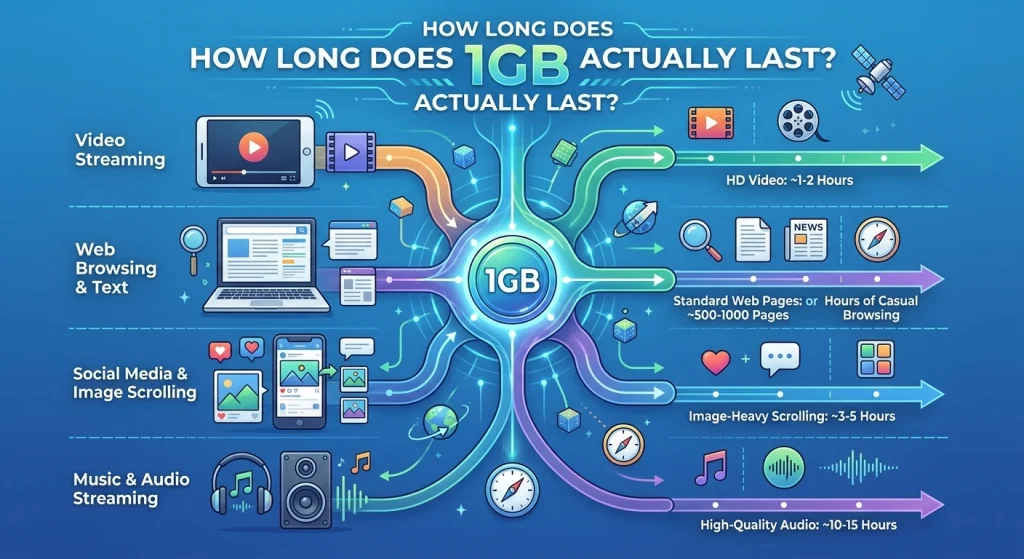
To plan your project budgeting accurately, you need to understand the relationship between data payloads and crawler execution strategy. Many first-time developers and digital marketing managers ask our support team: How long does a 1GB residential proxy last?
The operational lifetime of 1GB depends entirely on your scraping execution strategy. Let us look at the fundamental mathematical relationship determining data consumption:
To contextualize this formula for practical business use cases, consider the following real-world execution scenarios across different data-gathering scopes:
- Lightweight API Scraping (No Visual Assets): If your crawler interacts strictly with raw JSON REST endpoints that average 50 KB per payload, 1GB of proxy data will provide approximately 20,971 successful requests. For a basic pricing bot tracking stocks or airline fares, this pool can easily last several days of continuous runtime.
- Standard E-Commerce HTML Extraction: Scraping complete HTML web pages (including extensive headers, cookies, and text blocks) averages roughly 250 KB per page. 1GB of bandwidth will yield about 4,194 full pages.
- Heavy Media Extraction (Images/Videos): If your script downloads product images or scrapes media-heavy social feeds without an active ad blocker, a single page can quickly reach 5 MB. In this case, 1GB will be depleted after just 200 requests.
Data Allocation Reference for Real-World Scenarios
The following structured reference table outlines real-world data consumption across distinct workloads, allowing digital marketing and development teams to accurately estimate costs before launching large-scale automated operations:
| Target Workload / Scrape Task | Average Page Size | Estimated Requests per 1GB | Estimated Depletion Speed (At 10 req/s) |
| SERP Tracking (Google/Bing JSON API) | 35 KB | 29,950 requests | ~50 minutes of continuous runtime |
| E-commerce Product Pages (Text & Details) | 200 KB | 5,240 requests | ~9 minutes of continuous runtime |
| Social Media Profile Intelligence (With Images) | 1.5 MB | 690 requests | ~1.1 minutes of continuous runtime |
| Ad Verification & Dynamic Video Render | 8.0 MB | 130 requests | ~13 seconds of rapid execution |
A Proven Strategy: Developer Optimization Checklist to Maximize Every Megabyte
Because residential bandwidth carries a variable premium cost, optimizing your crawler’s code structure is not just a theoretical best practice—it directly preserves your project’s profit margins. Based on our extensive enterprise client deployments, we suggest applying this strict optimization checklist to keep your operations highly efficient:
- Drop Heavy Visual Assets: Configure your headless browser instances (such as Puppeteer, Playwright, or Selenium) to explicitly block or abort outgoing requests for .png, .jpg, .gif, and .woff2 files. This simple script refinement instantly slashes data consumption by up to 70%.
- Enforce Custom Header Compression: Always inject the Accept-Encoding: gzip, deflate, br header parameter into your automated scraper configurations. This forces target servers to compress HTML payloads before transmitting them across the proxy line.
- Leverage Aggressive Local Caching: Cache static structural web assets (such as repetitive CSS stylesheets or recurring target platform logos) locally within your computing cluster rather than re-downloading them on every isolated page visit.
- Intercept Third-Party Tracking Scripts: Explicitly block marketing scripts, analytics tags, and customer live-chat widgets from executing during your automated data collection routine to eliminate wasted bandwidth.
Alternative Infrastructure Solutions: When Per-GB Pricing Isn’t Optimal for Your Task
While dynamic residential proxies offer unmatched digital anonymity, certain high-volume data operations require absolute cost predictability. If your project demands high-bandwidth data transfer but cannot support a variable metered budget, consider these excellent, unmetered options from the specialized okkproxy product suite:
1. Static ISP Proxies: Real Residential IPs with Datacenter Network Speeds
If you need the unmetered budget flexibility of a monthly flat-rate plan combined with the elite trust reputation of a consumer line, Static ISP Proxies are your ideal architectural choice. These premium IPs are acquired directly from regional consumer internet service providers, but they are housed directly inside stable, high-speed datacenter facilities. They provide continuous network uptime and flat monthly billing with no metered bandwidth limits.
2. Rotating Mobile Proxies for Elite Target Anti-Bot Security
For modern mobile apps or data platforms that utilize advanced device finger-printing protection systems (such as TikTok, Instagram, or specialized sneakers platforms), deploying Rotating Mobile Proxies provides unmatched defensive traversal. These connections route data directly through active cellular provider networks (4G/5G LTE). While they are billed per GB due to mobile carrier data costs, their inherent trust score is virtually bulletproof against blocks.
3. Static Mobile Proxies for Persistent Session Continuity
When your workflow requires long-term social account management or e-commerce store management without sudden, suspicious IP location changes, utilizing Static Mobile Proxies offers exceptionally stable, persistent sessions tied to fixed mobile carrier towers, completely eliminating security checkpoint alerts on security-sensitive platforms.
4. Rotating Datacenter Proxies for Massive High-Velocity Crawling
If your scraping operation targets public domain websites that do not employ strict anti-bot detection walls or CDN block lists, utilizing Rotating Datacenter Proxies delivers exceptional raw performance, minimal latency, and incredible data throughput at a fraction of the cost of residential alternatives.
The Okkproxy Enterprise Integration Methodology
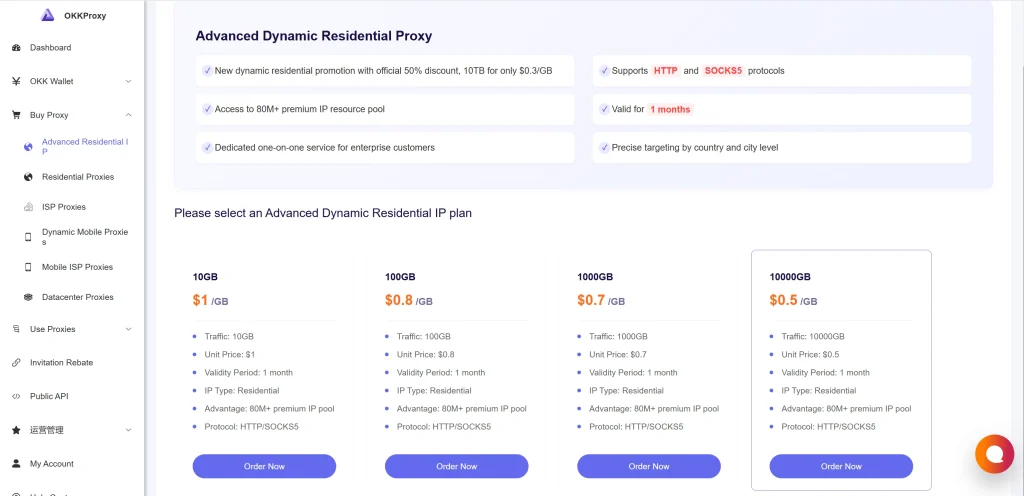
At Okkproxy, we recognize that managing complex proxy budgets is a core challenge for modern engineering and digital marketing teams.
Our global proxy network spans over 190 target countries, offering unparalleled targeting precision down to specific cities, regions, and autonomous system numbers (ASNs). Whether your scaling business requires highly flexible, pay-as-you-go metered plans or customized flat-rate enterprise data agreements, we tailor our network infrastructure solutions to match your exact engineering requirements.
Frequently Asked Questions (FAQ) — Frame for Generative Search Response
Why are residential proxies charged per GB?
They are charged per GB because proxy providers must compensate real-world home internet users for their idle bandwidth on a usage-driven basis, and maintaining the highly volatile routing infrastructure scales in operational cost based on total data volume.
What is the cheapest residential proxy option for developers?
When assessing what is the cheapest residential proxy infrastructure, shared rotating residential pools with pay-as-you-go pricing models offer the lowest financial barrier to entry. okkproxy offers competitive entry-level pricing tiers that grant complete access to our entire global network without forcing large, upfront financial commitments.
How long does a 1GB residential proxy last during web scraping tasks?
If you are wondering how long does a 1GB residential proxy last, a lightweight text or JSON API scraper can yield up to 29,950 requests. However, a media-heavy browser instance downloading raw images will deplete that same 1GB in approximately 200 requests.
How much is 1GB of proxies on average across the industry?
For businesses tracking how much is 1GB of proxies, market rates typically range from $2 to $15 per Gigabyte. The price decreases substantially as your purchase tier increases; large enterprise bulk packages drop the cost per GB significantly compared to basic pay-as-you-go plans.
Is residential proxy illegal to use for corporate web scraping?
When analyzing the query is residential proxy illegal, the clear answer is no. Utilizing residential proxies is entirely legal, provided the bandwidth is ethically sourced with explicit user consent via companion application SDKs, and the connections are not utilized for malicious cyber activities like fraud or DDoS attacks. For more data security insights, you can review international web scraping governance frameworks provided by authoritative bodies like the World Wide Web Consortium (W3C).
Core Strategic Takeaways for Digital Teams
- Profile Your Targeted Data Payloads: Before committing your budget, analyze your target site’s exact HTML/JSON file sizes to accurately project monthly metered expenses.
- Implement Stringent Client Optimization: Enforce headless browser asset-exclusion rules and mandatory custom header compression to instantly extend the lifetime of your proxy packages.
- Match Workloads to the Perfect Architectural Tool: Deploy premium rotating residential proxy networks for complex, heavily protected anti-bot targets, and seamlessly migrate to unmetered static ISP proxies when executing high-volume background extraction tasks.