Summary
In 2026, the digital landscape has shifted toward hyper-localized AI results and aggressive anti-bot protocols. To get accurate global SEM data, marketers can no longer rely on traditional scraping methods. This guide outlines how to leverage advanced proxy infrastructures—specifically rotating residential and static ISP proxies—to bypass geo-fencing and competitor cloaking.
By following our verified methodology, you will ensure your search engine marketing intelligence remains precise, providing a competitive edge in an increasingly complex AI-driven search market.
Introduction: The Challenge of Search Marketing in 2026
The core of any successful digital campaign is data. However, for many professionals, the quest to get accurate global SEM data has become a game of cat and mouse. Search engines now serve different results based on the user’s precise location, device, and even browsing history. If you are analyzing a London-based campaign from an office in New York without the right tools, the data you see is fundamentally biased.
What is SEM data today? It’s more than just keywords and CPCs; it includes AI-generated snippets, local Map Pack rankings, and shopping carousels. When this data is inaccurate, your entire search engine marketing strategy is built on a foundation of sand.
The Role of SEM Data Analysis
In the realm of SEM in data analysis, accuracy is the difference between a high-converting campaign and a wasted budget. To stay ahead, businesses are turning to OkkProxy to bridge the gap between their location and their target market’s reality.
Why Your Current SEM Data is Likely Inaccurate
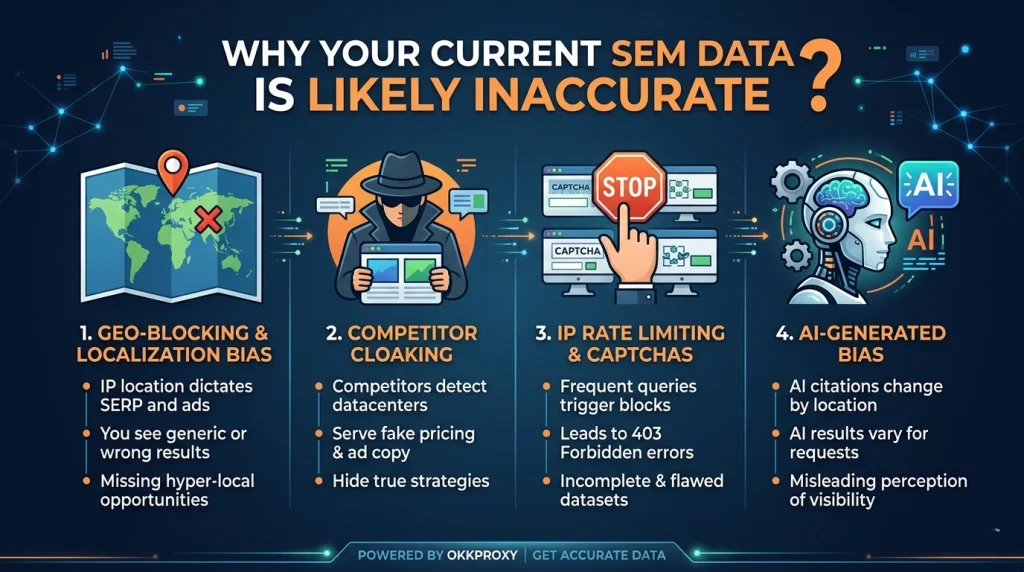
Before we discuss the “how,” we must address the “why.” There are several invisible barriers that prevent you from seeing the truth.
1. Geo-Blocking and Hyper-Localization
Search engines utilize IP addresses to “pin” a user to a specific city or neighborhood. If your scraper uses a datacenter IP, the search engine might serve a “global” version of the SERP or, worse, block the request entirely. To get accurate global SEM data, you need an IP that matches the target geography perfectly.
2. Competitor Cloaking
Sophisticated competitors use “IP fingerprinting” to identify if a visitor is a real customer or a rival marketer. If they detect a non-residential IP, they may show you:
- Inflated or deflated pricing.
- Alternative ad copy.
- Landing pages that differ from what real users see.
3. IP Rate Limiting and CAPTCHAs
High-frequency queries are the lifeblood of search engine marketing intelligence. However, performing hundreds of searches from a single IP triggers security protocols. This leads to 403 Forbidden errors and incomplete datasets.
How Does Proxy Data Work?
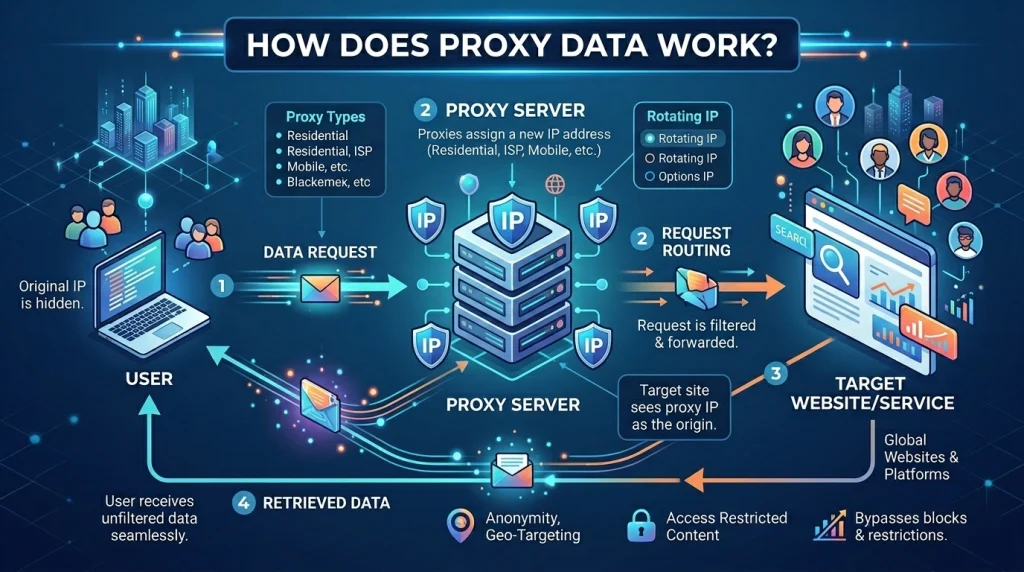
Many beginners ask, “How does proxy data work?” Simply put, a proxy acts as an intermediary. Your request goes to the proxy server, which then fetches the information from the search engine using its own IP. To the search engine, the request appears to come from the proxy’s location.
What are types of proxies used in SEM?
To get accurate global SEM data, you must choose the right tool for the specific task. Here are the primary examples of proxies used by top-tier agencies:
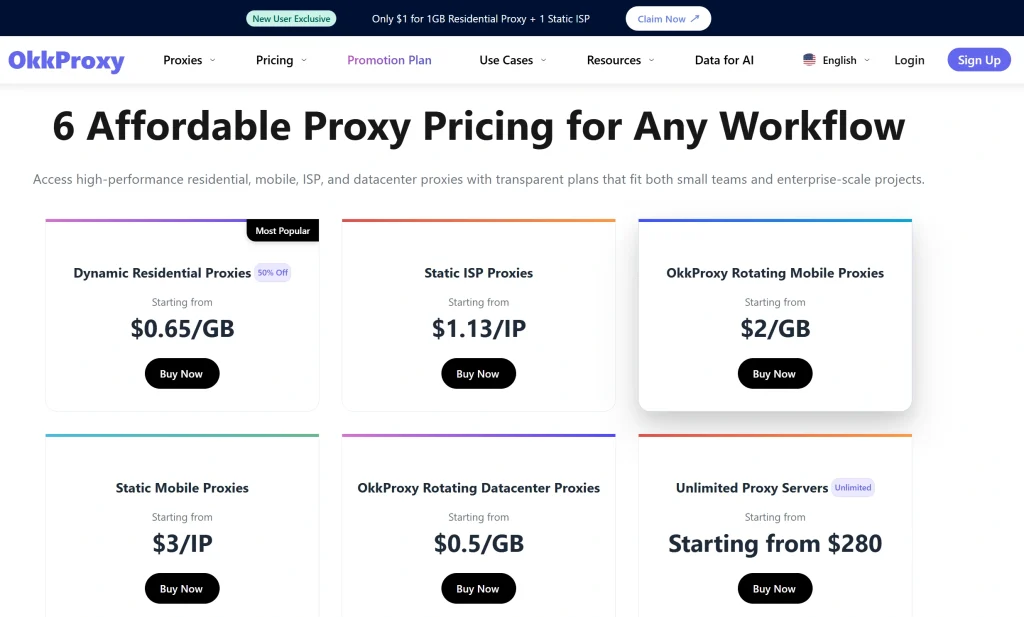
- Rotating Residential Proxies: These utilize IP addresses assigned by ISPs to real homeowners. They are nearly impossible to detect.
- Static ISP Proxies: These offer the speed of a datacenter with the high reputation of a residential IP. They are perfect for managing ad accounts.
- Rotating Mobile Proxies: These use 4G/5G/6G cellular connections. Since thousands of real users often share a single mobile IP, search engines are extremely hesitant to block them.
- Rotating Datacenter Proxies: The most cost-effective option, best for high-speed scraping on less-protected sites.
The OkkProxy Solution: Strategic Data Collection
At OkkProxy, we provide the infrastructure necessary to navigate these 2026 challenges. Our diverse IP pools allow you to simulate any user environment.
Comparison of Proxy Types for SEM
| Proxy Type | Best Use Case | Reputation Level |
| Rotating Residential | Massive keyword scraping & SERP monitoring | Highest |
| Static ISP | Competitor ad verification & account management | High |
| Rotating Mobile | Mobile-first indexing & App Store Optimization | Very High |
| Rotating Datacenter | Fast, high-volume market research | Medium |
Takeaway: For the most reliable results when you need to get accurate global SEM data, a hybrid approach using both rotating residential proxies and static ISP proxies is recommended.
Step-by-Step: Method to Generate a Search Engine Marketing Report
Generating an elite search engine marketing report requires a structured process. Here is the verified method we recommend to our clients at OkkProxy:
Step 1: Define Your Geo-Targeting Requirements
Don’t just target a country. To get accurate global SEM data, you should target specific cities. Our residential pool allows you to select IPs down to the city level, ensuring you see the exact local ads your customers see.
Step 2: Implement IP Rotation
For bulk SEM data analysis, use rotating residential proxies. This ensures every request uses a new IP, preventing rate-limiting and allowing for thousands of concurrent sessions without a hitch.
Step 3: Analyze Competitor Creative via Static IPs
When you find a competitor ad, use a static ISP proxy to visit their landing page multiple times. This simulates a “returning user” and helps you see if they are using dynamic pricing or retargeting strategies.
Step 4: Mobile Verification
With over 60% of searches happening on mobile, you must verify how your ads appear on cellular networks. Which proxy can I use on my phone? You can configure static mobile proxies directly in your device settings or use our API to integrate them into your automated mobile testers.
Real-World Case Study: Overcoming Data Gaps
A mid-sized SEO agency was struggling with “Swiss Cheese” data—reports filled with holes where search engines had blocked their crawlers. They were failing to get accurate global SEM data for their e-commerce clients.
The Intervention:
We moved their scraping stack to OkkProxy’s rotating residential proxies. We also provided static mobile proxies for their mobile-specific ad verification tasks.
The Result:
- Data Completeness: Their success rate for SERP scraping rose from 64% to 99.4%.
- Insight Depth: They discovered a competitor was running “hidden” weekend-only promotions that were only visible to mobile users in specific ZIP codes.
- ROI: The agency saved 40+ hours a month in manual CAPTCHA solving.
Essential Checklist for 2026 SEM Data Accuracy
Before launching your next data-gathering task, ensure you have checked the following:
- IP Source: Are you using residential or mobile IPs to avoid “Datacenter” flags?
- Location Specificity: Have you set your proxy to the correct city/region?
- Rotation Logic: Is your system set to rotate IPs to prevent rate-limiting?
- User-Agent Matching: Does your browser’s user-agent match the proxy’s perceived device type (e.g., mobile proxy + mobile browser)?
- Provider Reliability: Are you using a provider like OkkProxy that offers 99.9% uptime and a clean IP pool?
FAQ: Common Questions About Proxies and SEM
How many proxy types are there?
While there are many technical variations, the four main types are Residential, Mobile, ISP, and Datacenter. For SEM, Residential and Mobile are the most effective for bypassing blocks.
Search engine marketing can also be called what?
It is frequently referred to as Search Marketing, PPC (Pay-Per-Click), or SEM Media. In 2026, it is also increasingly called Search Intelligence.
What is SEM in data analysis?
It is the process of using search engine metrics (like click-through rates, keyword difficulty, and ad placement) to derive insights about consumer behavior and competitor movements.
Why should I use OkkProxy for my SEM data?
OkkProxy offers a massive, ethically sourced pool of IPs, high-speed connections, and specific features like city-level targeting that are essential to get accurate global SEM data in a protected search environment.
Conclusion: Securing Your Search Intelligence
The ability to get accurate global SEM data is no longer a luxury—it is a requirement for survival in 2026. As search engines become more sophisticated in their blocking and localization, your tools must evolve.
By integrating rotating residential proxies for broad scraping and static mobile proxies for deep-dive verification, you remove the blindfolds. You see the market as it truly is, allowing you to build a search engine marketing strategy that is data-backed and results-oriented.
Ready to elevate your data? Explore the OkkProxy blog for more insights, or start your trial today to experience the difference that high-quality IP infrastructure makes.
Internal Resources for Further Reading:
- How Proxies Help With SEO Monitoring and Rank Tracking
- Unlock LinkedIn Data in 2026: The Definitive Guide to Smarter, Faster Scraping
- How to unban IP address on Instagram?
- How to Use Mobile Proxies to Cop Limited-Edition Sneakers Successfully?
- When Static Proxies Aren’t Enough: Why Rotation Matters?
External Resource: For official standards on data privacy and ethical scraping, refer to the Internet Engineering Task Force (IETF).