Summary:
Feeding real-time, high-fidelity web data to Large Language Models (LLMs) requires choosing between managed Scraping APIs and Raw Proxies. Scraping APIs excel at fast deployment, automated browser rendering, and producing token-efficient Markdown for RAG pipelines and AI agents.
Conversely, Raw Proxies (rotating residential, static ISP, dynamic datacenter, dynamic/static mobile) deliver superior cost-efficiency at high volumes, custom session control, and granular flexibility. Evaluating a Scraping API vs Proxy architecture comes down to balancing engineering resources, scraping volume, and token budget.
The Real-Time Web Data Bottleneck for LLMs
Large Language Models (LLMs) have transformed automated decision-making and natural language processing. However, two persistent challenges remain: static training cutoffs and hallucinations when answering questions about current events or dynamic live data. To bridge this gap, modern AI architectures rely on Retrieval-Augmented Generation (RAG) and real-time autonomous AI agents equipped with live web browsing capabilities.
Whether you are building a real-time e-commerce price monitor, a financial intelligence bot, or a property valuation engine, your LLM is only as effective as the accuracy and freshness of its context window. Connecting an AI model to the live web brings a core architectural decision: Should you use a managed Web Scraping API or build a custom scraper using Raw Proxies?
In this guide, we evaluate the Scraping API vs Proxy dynamic across technical performance, token efficiency, anti-bot defenses, and cost structures to help you choose the ideal pipeline for your data architecture.
Core Definitions: Scraping APIs vs. Raw Proxies
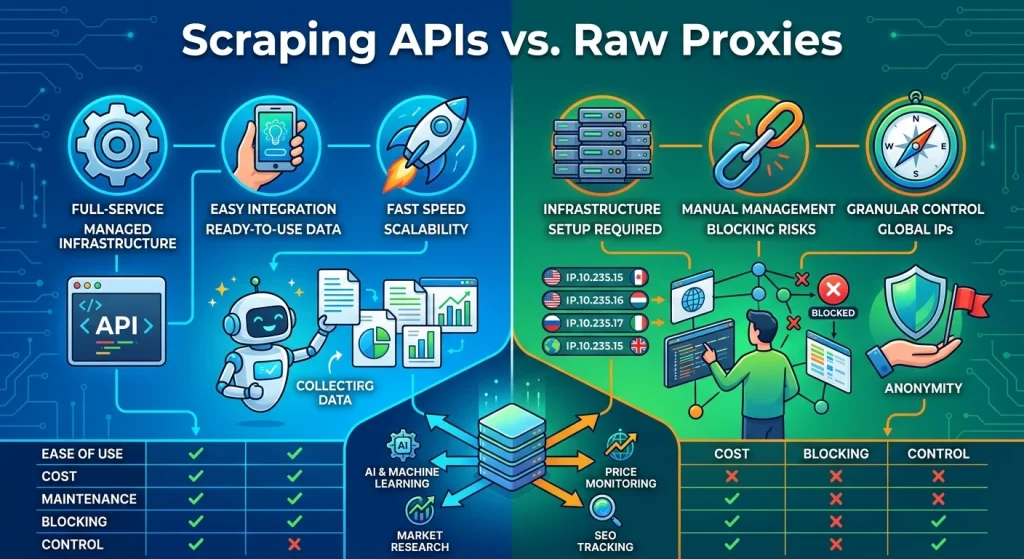
Understanding the technical distinction between these two solutions helps clarify their ideal use cases:
- What is a Web Scraping API?
- A web scraping API (such as Firecrawl, ScraperAPI, or custom universal scraping APIs) is a fully managed cloud endpoint. You submit a target URL via an API request, and the platform handles proxy management, headless browser rendering, CAPTCHA solving, and DOM parsing—returning clean Markdown or structured JSON ready for prompt injection.
- What is a Raw Proxy?
- A raw proxy is a network relay node operating at the transport layer (HTTP/HTTPS/SOCKS5) that routes client traffic through an intermediate IP address, masking your true server origin. Raw proxies do not parse HTML or run JavaScript on their own.
Technical Comparison: Web Scraping API vs. Raw Proxy
When evaluating a Scraping API vs Proxy setup for LLM real-time data pipelines, consider the breakdown of core features:
| Feature / Metric | Managed Web Scraping API | Raw Proxies (via OkkProxy Infrastructure) |
| Primary Output | Clean Markdown, clean text, or structured JSON | Raw HTML response bytes or network stream |
| Infrastructure Overhead | Zero (fully managed by API vendor) | High (requires local headless browsers & parsers) |
| Anti-Bot Defense | Managed (automated TLS spoofing & CAPTCHA solving) | Maintained via custom fingerprinting + rotating residential/mobile IPs |
| JavaScript Rendering | Server-side Chromium rendering included | Handled locally via Playwright, Puppeteer, or Selenium |
| Token Efficiency | High (automatically strips navigation, ads, & scripts) | Variable (depends on custom internal parsing scripts) |
| Cost Model | Billed per successful API request/credit | Billed per GB of network bandwidth |
| Latency | 2,500ms – 8,000ms (due to cloud rendering) | 50ms – 400ms (direct proxy socket connection) |
| Session Control | Primarily stateless / short-lived execution | Complete control over cookies, headers, & sticky session duration |
| Best For | AI Agents, RAG pipelines, rapid MVP deployment | High-volume data mining, enterprise ETL, session-heavy bots |
Why Web Scraping APIs Excel for LLM Data Pipelines
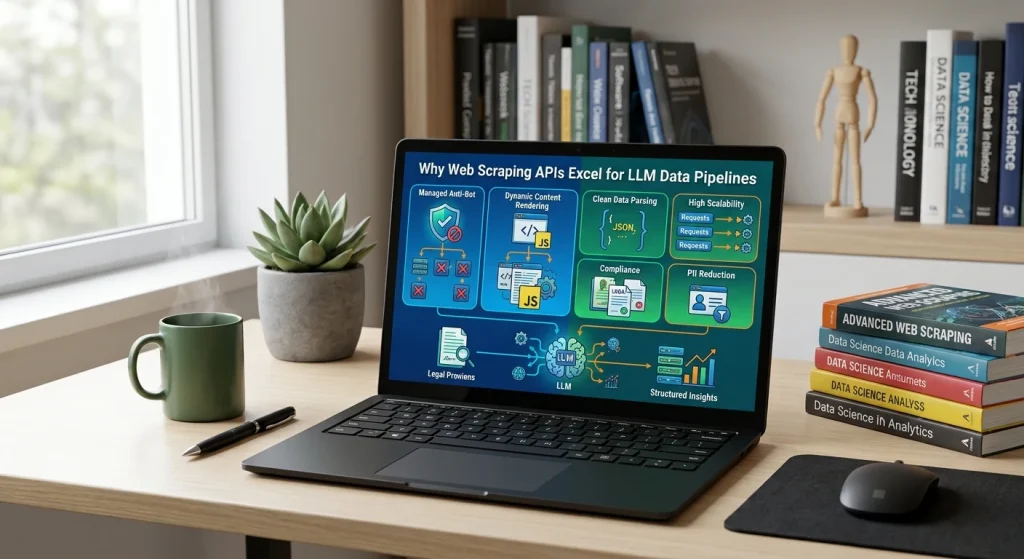
When feeding real-time web content into LLMs, managed scraping APIs simplify pipeline design in three key ways:
1. Eliminating the Headless Browser Resource Tax
Modern web applications rely heavily on JavaScript frameworks like React, Vue, and Next.js. Simple HTTP GET requests often return empty skeleton frames (<div id=”root”></div>).
When using raw proxies, client applications must run headless browsers (such as Puppeteer or Playwright) to execute JavaScript. This introduces significant infrastructure overhead:
- A single headless Chromium tab consumes 150 MB to 350 MB of RAM.
- Running 100 concurrent scrapers requires 32 GB+ RAM and high CPU overhead.
A universal web scraping API offloads browser rendering to cloud infrastructure, keeping your LLM application servers lightweight.
2. Token Optimization and Clean Markdown Formatting
LLMs operate on context windows with costs tied directly to input token counts. Raw HTML contains extensive clutter: inline CSS, scripts, header navigation, footers, and tracking pixels. Passing uncleaned HTML to an LLM wastes tokens and dilutes attention performance.
Specialized AI scraping tools strip non-essential DOM nodes and convert main body text into structured Markdown, reducing token usage by 85% to 95%.
3. Automated Handling of Anti-Bot Defenses
Modern web defense platforms (Cloudflare, Akamai, Kasada) inspect incoming traffic across multiple vectors:
- TLS Fingerprinting: Detecting non-browser HTTP clients (such as Python requests or curl) via JA3/JA4 signatures.
- Browser Environment Probing: Checking navigator.webdriver flags and Chrome DevTools Protocol (CDP) signatures.
- Behavioral Tracking: Analyzing request intervals and interaction patterns.
Scraping APIs handle fingerprint rotation and CAPTCHA solving behind the scenes, reducing pipeline maintenance.
When Raw Proxies Win: Enterprise Scale & Session Control
While Web Scraping APIs streamline early-stage development, raw proxies remain the foundation for high-volume enterprise data pipelines.
1. Superior Cost Efficiency at Enterprise Volumes
In any Scraping API vs Proxy evaluation, pricing structures play a central role. Scraping APIs typically charge per request (often $0.001 to $0.005 per request). For high-volume enterprise operations, this pricing model scales rapidly:
- Scraping API Cost (50M requests/month): 50,000,000×$0.002=$100,000/ month
- Raw Proxy Cost via OkkProxy:
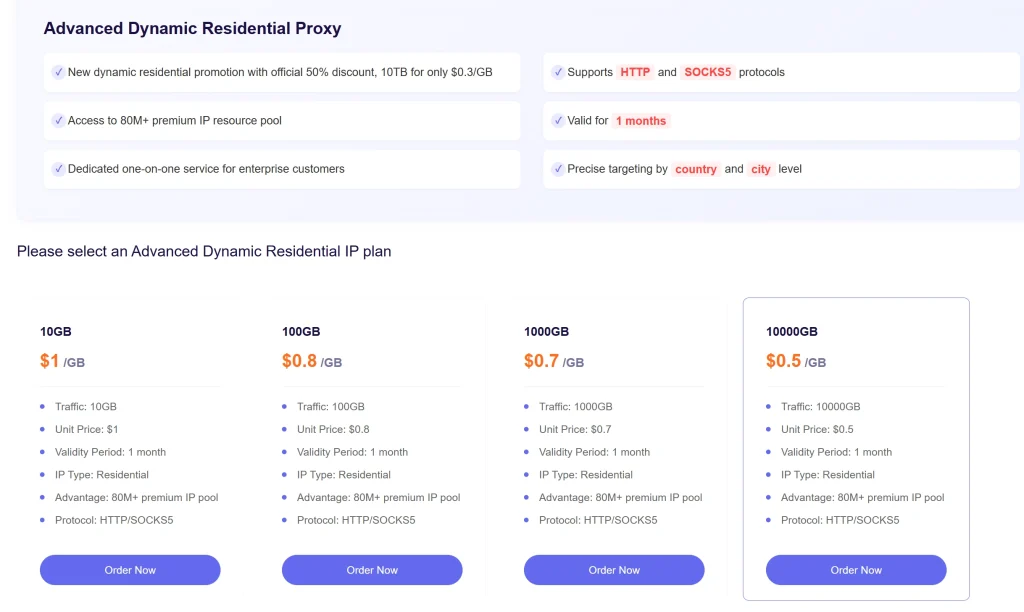
- 50 million lightweight HTML requests typically equal ~1.5 TB of traffic. Using OkkProxy Rotating Residential Proxies at $0.50/GB: 1,500GB×$0.50=$750/ month
Even accounting for server infrastructure and maintenance overhead, raw proxies provide significant cost advantages at high volumes.
2. Deep Session Persistence and Multi-Step Automation
Complex AI agent workflows—such as authenticating into member portals, searching internal catalogs, and performing multi-step actions—require persistent session state. Scraping APIs operate primarily as stateless endpoints, making extended stateful navigation difficult.
Using OkkProxy Static ISP Proxies or Static Mobile Proxies, you maintain static residential IP sessions for extended periods, preserving cookies, local storage, and authentication tokens across multi-step browser interactions.
Architectural Deep-Dive: Combining Scraping Pipelines with LLM Proxies
In enterprise AI architectures, data acquisition works alongside an LLM proxy (such as LiteLLM, LiteLLM AI Gateway, or Zscaler LLM Proxy) to manage security, monitoring, and model routing.
Key Responsibilities of an LLM Proxy:
- PII Masking & Privacy: Redacts personally identifiable information (PII) before sending scraped web content to third-party LLM providers.
- Model Load Balancing: Dynamically routes prompts across providers (OpenAI GPT-4o, Anthropic Claude 3.5 Sonnet, or local models) to optimize cost and speed.
- Caching & Rate Limiting: Caches duplicate web queries to avoid unnecessary model inference calls.
Field Experience: Real-World Enterprise Case Studies
Case Study 1: Scaling E-Commerce Price Intelligence
- Challenge: A global e-commerce analytics brand needed to track prices, inventory status, and user reviews across 50,000 SKUs hourly on major retail sites. Managed scraping APIs were projected at $35,000+/month.
- Solution: The team built a dedicated scraping pipeline using OkkProxy Rotating Residential Proxies paired with async HTTP clients and custom browser fingerprinting.
- Result: Reduced operational data acquisition costs by 78% while maintaining a 99.4% request success rate across strict retail anti-bot systems.
Case Study 2: Real Estate Intelligence with Automated PostgreSQL Ingestion
- Challenge: A PropTech platform required automated scraping of property listings and price histories from Zillow and Redfin to update an Automated Valuation Model (AVM).
- Solution: The engineering team deployed OkkProxy Static ISP Proxies for persistent session stability, feeding structured listing data into a PostgreSQL pipeline before surfacing summaries to their AI evaluation agent.
- Result: Achieved 0 IP bans across 180 consecutive days of operational scraping with sub-300ms network response times.
Practical Code Walkthrough: Building an AI-Ready Web Scraper
Below is a Python implementation using httpx and BeautifulSoup routed through OkkProxy Rotating Residential Proxies to collect web content and format it into clean Markdown for LLM ingestion.
Python
import httpx
from bs4 import BeautifulSoup
import asyncio
# OkkProxy Residential Proxy Configuration
PROXY_HOST = “pr.okkproxy.com”
PROXY_PORT = “8000”
PROXY_USER = “customer_12345”
PROXY_PASS = “your_secure_password”
PROXY_URL = f”http://{PROXY_USER}:{PROXY_PASS}@{PROXY_HOST}:{PROXY_PORT}”
def extract_clean_markdown(html_content: str) -> str:
“””Strips HTML clutter and converts main content into clean Markdown.”””
soup = BeautifulSoup(html_content, “html.parser”)
# Remove script, style, and navigation tags
for element in soup([“script”, “style”, “nav”, “footer”, “header”, “aside”, “iframe”]):
element.decompose()
main_body = soup.find(“main”) or soup.find(“article”) or soup.body
if not main_body:
return “”
text = main_body.get_text(separator=”\n”)
cleaned_lines = [line.strip() for line in text.splitlines() if line.strip()]
return “\n\n”.join(cleaned_lines)
async def scrape_url_for_llm(target_url: str) -> str:
headers = {
“User-Agent”: “Mozilla/5.0 (Windows NT 10.0; Win64; x64) AppleWebKit/537.36 (KHTML, like Gecko) Chrome/125.0.0.0 Safari/537.36”,
“Accept-Language”: “en-US,en;q=0.9”,
}
async with httpx.AsyncClient(proxies=PROXY_URL, timeout=12.0) as client:
response = await client.get(target_url, headers=headers)
if response.status_code == 200:
return extract_clean_markdown(response.text)
else:
raise Exception(f”Request failed with status code: {response.status_code}”)
# Example invocation:
# markdown_output = asyncio.run(scrape_url_for_llm(“https://example.com/product/123”))
Infrastructure Checklist & Strategic Decision Matrix
Use this decision matrix to determine the right data ingestion strategy for your project:
Evaluation Checklist:
- Scraping Volume: Are you scraping fewer than 100,000 pages per month?
- Use a Managed Web Scraping API for rapid integration and zero maintenance.
- Latency Requirements: Do you require sub-second data ingestion for live RAG feeds?
- Use Raw Proxies (OkkProxy Static ISP / Rotating Datacenter) + async HTTP requests.
- Anti-Bot Sophistication: Are target sites protected by strict Cloudflare or Akamai challenges?
- Use OkkProxy Rotating Residential Proxies or Rotating Mobile Proxies.
- Session State: Does your workflow require multi-step logins, user accounts, or shopping carts?
- Use OkkProxy Static Residential / Static Mobile Proxies with browser automation.
- Scale & Budget: Does your application extract over 5 million pages monthly?
- Use Raw Proxies to significantly reduce bandwidth and infrastructure costs.
Frequently Asked Questions (FAQ)
Thoughts on API vs proxies for web scraping?
Web Scraping APIs prioritize speed and simplicity by combining proxy rotation, browser rendering, and parsing into a single endpoint. Raw proxies provide maximum control, lower latency, and substantial cost savings for enterprise-scale pipelines.
Is web scraping illegal in the US?
No. Standard web scraping of publicly accessible data is generally legal under US legal precedents (e.g., hiQ Labs v. LinkedIn). However, accessing non-public data behind authentication, bypassing technological paywalls, or violating terms of service can create legal risk.
Can ChatGPT do web scraping?
Yes. ChatGPT uses internal browsing capabilities (such as Web Browsing tools) to pull current web information. For custom software applications, developers connect LLMs to scraping APIs or raw proxy pipelines via RAG frameworks.
Is it unethical to scrape websites?
Collecting public web data for market research, price comparisons, or machine learning model training is widely accepted. Ethical practices include adhering to request rate limits, respecting server resources, and safeguarding personal data (PII).
Which proxies are best for web scraping?
- Rotating Residential Proxies: Ideal for bypassing anti-bot systems on major e-commerce and search platforms.
- Static ISP Proxies: Ideal for persistent sessions, user accounts, and high-speed data extraction.
- Rotating Mobile Proxies: Ideal for hyper-localized targeting and mobile app scraping.
- Static Mobile Proxies: Ideal for long-term account management and social platform scraping.
- Rotating Datacenter Proxies: Ideal for high-speed, cost-effective extraction on unprotected sites.
How do universal web scraping APIs bypass complex web blocks and anti-scraping measures?
Universal scraping APIs bypass anti-bot defenses by rotating underlying residential proxies, managing TLS/JA4 browser fingerprints, executing JavaScript via headful Chrome instances, solving CAPTCHAs, and introducing randomized request timing.
Key Takeaways
- Align Infrastructure with Scale: Choose managed Web Scraping APIs for rapid prototyping and low-volume AI agents. Transition to raw proxy infrastructure from OkkProxy for high-volume, cost-sensitive data operations.
- Optimize Context Tokens: Convert raw HTML into clean Markdown or structured JSON before prompt injection to minimize LLM token costs and improve response relevance.
- Deploy Multi-Layered Defenses: Combine high-reputation OkkProxy Rotating Residential Proxies with browser header and TLS management to build resilient scraping pipelines.
- Secure the AI Gateway: Use an LLM proxy (such as LiteLLM) to handle PII redaction, control model access, and monitor token usage.
Related Guides & OkkProxy Resources
For additional technical insights on proxy strategies and scraping architectures, explore our technical guides:
- The Ultimate Guide to Running Discord Scrapers Without Getting Banned
- Real-Time Stock Data Scraping from Yahoo Finance with Python & Proxies for Scalable Automation
- Get Accurate Global SEM Data in 2026 (Without Getting Blocked)
- E-commerce Price Data Collection: What You Need to Know
- How Websites Detect Proxy Traffic and Gradually Increase CAPTCHA Levels