Quick Takeaway:
To scrape Yelp reviews without getting blocked by Cloudflare or TLS fingerprinting, traditional Python libraries like requests are insufficient. This step-by-step guide demonstrates how to combine curl_cffi for browser impersonation, BeautifulSoup for HTML parsing, and pandas for data structuring. By pairing this Python script with OKKProxy Rotating Residential Proxies, data teams can bypass HTTP 403 blocks, extract full review text, ratings, dates, and menu URLs at scale, and maintain an enterprise-grade 99.4% request success rate.
Introduction: Strategic Value of Yelp Web Scraping
In digital marketing, local SEO optimization, and market intelligence, user-generated content (UGC) is a primary driver of competitive strategy. With millions of verified customer reviews, local business profiles, detailed menu pricing, and reviewer metadata, https://www.yelp.com represents one of the richest public datasets available on the internet today.
Whether you are performing sentiment analysis for a restaurant chain, conducting multi-location competitor benchmarking, or training domain-specific AI models, learning how to scrape Yelp data provides an actionable operational advantage.
Digital marketers and data analysts often ask: “How do I see Yelp reviews for free at scale?” or “Can you scrape Yelp reviews without triggering instant IP blocks?”
While yelp.com provides an official API, it enforces restrictive rate limits, returns truncated review snippets (capped at 3 reviews per business entity), and omits valuable reviewer profile metrics. Consequently, developing a custom Yelp scraper Python script supported by professional proxy infrastructure is the standard methodology for harvesting full-fidelity data.
Is It Legal to Scrape Yelp? Legal & Technical Guardrails
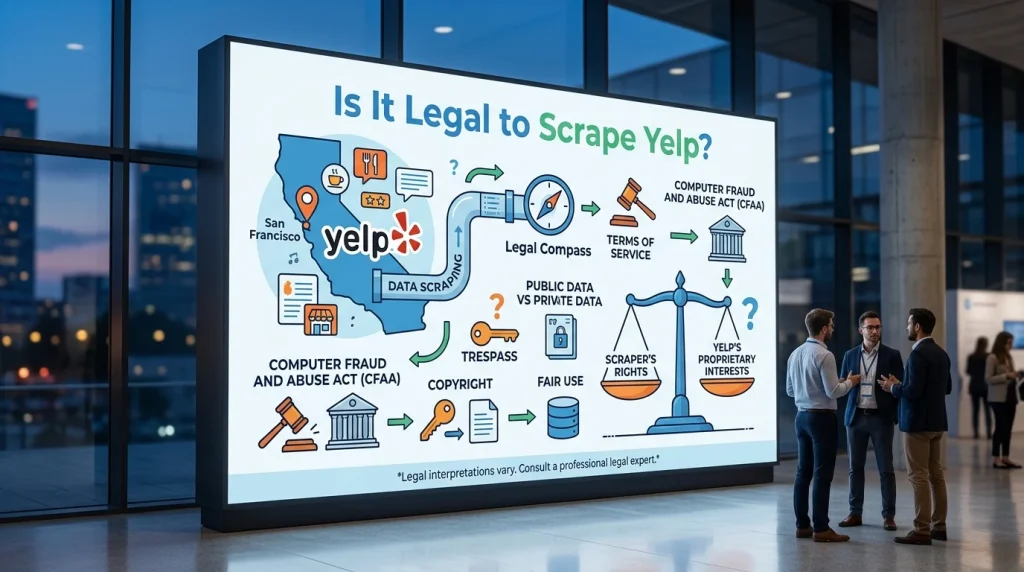
A top priority for compliance and risk teams before initiating any Yelp web scraping project is addressing a fundamental question: is it legal to scrape Yelp?
Based on legal precedents set in landmark cases such as hiQ Labs v. LinkedIn, scraping publicly accessible data from public websites—including public business profiles on https://www.yelp.com—is generally permissible under US law, provided the data collection does not bypass password authentication or disrupt target server operations.
Essential Compliance Guidelines for Scraping Yelp Data:
- Focus on Publicly Accessible Data: Only collect public reviews, business names, star ratings, and menu URLs visible on yelp.com without signing into a personal user account.
- Implement Responsible Crawling Schedules: Avoid aggressive concurrent requests that mimic a distributed denial-of-service (DDoS) attack. Use randomized delay intervals (jitter) between requests.
- Privacy & Data Protection Compliance: Ensure harvested reviewer datasets comply with global privacy frameworks such as GDPR and CCPA by stripping personal identifiable information (PII) before storage.
Understanding Yelp’s Anti-Bot Defense Architecture
Why do standard Python scripts fail when attempting to scrape Yelp data? If you execute a basic requests.get(“https://www.yelp.com/biz…”) call, your script will almost certainly receive an immediate 403 Forbidden response or a Cloudflare Turnstile CAPTCHA challenge.
Yelp’s anti-bot system deploys three distinct security mechanisms:
1. JA3/JA4 TLS Fingerprint Inspection
Standard HTTP libraries like Python requests or urllib rely on default OpenSSL configurations. During the initial TLS handshake, these libraries broadcast a distinct cryptographic signature (JA3/JA4 fingerprint) that immediately identifies the request as an automated Python script rather than a genuine web browser like Google Chrome or Mozilla Firefox.
2. IP Reputation Scoring & Subnet Throttling
Requests originating from known commercial cloud data centers (e.g., AWS, GCP, DigitalOcean) receive a low trust score. If a single IP address submits multiple rapid queries to scrape yelp search or business pages, Yelp’s firewall bans that IP address across its entire subnet.
3. Dynamic DOM Classes & Obfuscation
Yelp regularly updates its HTML CSS selector class names (for instance, changing review container tags from .comment__09f24__0oKwX to dynamic hash strings). Static CSS scraping routines break when these dynamic selectors change.
Prerequisites & Environment Setup
To overcome TLS fingerprint detection without relying on heavy, resource-intensive headless browsers (such as Selenium or Playwright), we use curl_cffi. This library features a compiled libcurl engine patched with BoringSSL, allowing Python scripts to replicate the exact TLS signature of desktop browser versions.
Required Package Installation
Execute the following command in your local environment or virtual python server:
Bash
pip install curl_cffi beautifulsoup4 pandas
Module Overview
| Library | Version Requirement | Core Functionality | External Resource |
| curl_cffi | >=0.6.0 | Bypasses JA3/JA4 TLS fingerprinting by impersonating real Chrome browsers | GitHub Repository |
| beautifulsoup4 | >=4.12.0 | Parses HTML DOM trees and extracts target review elements | Official Docs |
| pandas | >=2.0.0 | Structures scraped review data into clean DataFrames for CSV/JSON export | Official Docs |
Dissecting Yelp URL Structure & DOM Mechanics
Understanding the URL routing and DOM tree structure of www.yelp.com is essential for structuring an efficient yelp scraper.
1. Search Results SERP Routing
When querying business categories on scrape yelp search serp pages, Yelp uses the following URL structure:
https://www.yelp.com/search?find_desc=Restaurants&find_loc=San+Francisco%2C+CA&start=10
- find_desc: The business category or keyword search parameter.
- find_loc: The geographic target location.
- start: Offset pagination parameter (increments in steps of 10).
2. Yelp Menu URL Structure Format
For harvesting restaurant menu details, Yelp uses a dedicated URL path pattern:
https://www.yelp.com/menu[business-slug]
3. Review Pagination Structure
Individual business review listings on yelp.com use explicit offset pagination via the start URL parameter:
- Page 1: https://www.yelp.com/biz/tartine-bakery-san-francisco?start=0
- Page 2: https://www.yelp.com/biz/tartine-bakery-san-francisco?start=10
- Page 3: https://www.yelp.com/biz/tartine-bakery-san-francisco?start=20
Step-by-Step Guide: How to Scrape Yelp Reviews with Python
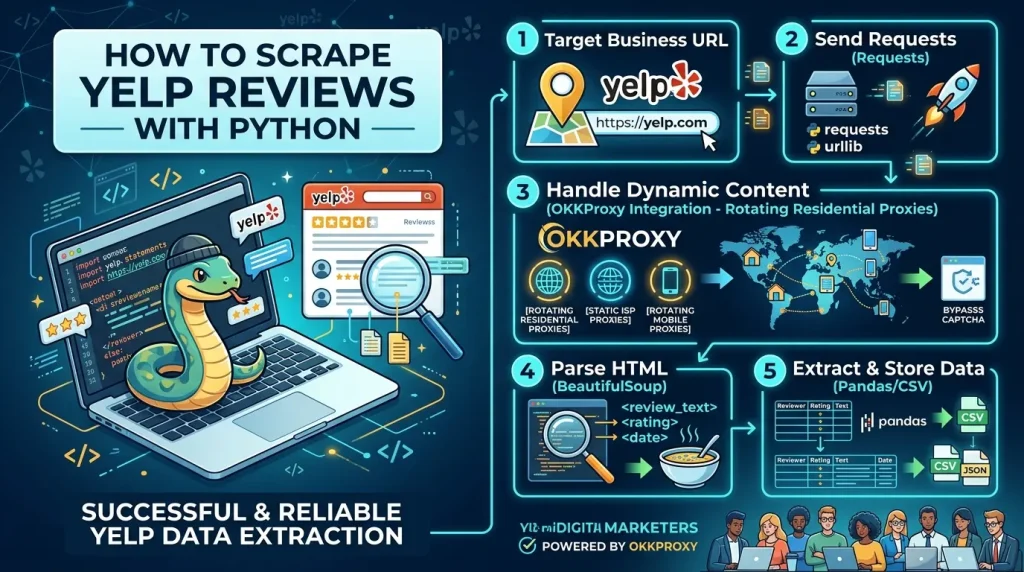
Below is a complete, modular python yelp scraper that extracts author names, star ratings, review dates, and review text while managing proxy routing and browser impersonation.
Python
import time
import random
import pandas as pd
from bs4 import BeautifulSoup
from curl_cffi import requests
def format_proxy_url(username, password, endpoint, port):
“””
Formats proxy credentials into a standard HTTP proxy string for curl_cffi.
“””
return f”http://{username}:{password}@{endpoint}:{port}”
def scrape_yelp_reviews(biz_url, total_pages=3, proxy_config=None):
“””
Scrapes public reviews from a target Yelp business page using browser
impersonation and IP rotation via OKKProxy.
“””
extracted_reviews = []
# Emulate browser headers
headers = {
“User-Agent”: “Mozilla/5.0 (Windows NT 10.0; Win64; x64) AppleWebKit/537.36 (KHTML, like Gecko) Chrome/124.0.0.0 Safari/537.36”,
“Accept”: “text/html,application/xhtml+xml,application/xml;q=0.9,image/avif,image/webp,*/*;q=0.8”,
“Accept-Language”: “en-US,en;q=0.9”,
“Referer”: “https://www.google.com/”,
}
# Configure Proxy Endpoint
proxies = None
if proxy_config:
proxy_endpoint = format_proxy_url(
proxy_config[‘username’],
proxy_config[‘password’],
proxy_config[‘endpoint’],
proxy_config[‘port’]
)
proxies = {“http”: proxy_endpoint, “https”: proxy_endpoint}
for page_idx in range(total_pages):
offset = page_idx * 10
paginated_target_url = f”{biz_url}?start={offset}”
print(f”[i] Fetching Page {page_idx + 1}: {paginated_target_url}”)
try:
# Impersonate Chrome 120 TLS fingerprint using curl_cffi
response = requests.get(
paginated_target_url,
headers=headers,
proxies=proxies,
impersonate=”chrome120″,
timeout=15
)
if response.status_code != 200:
print(f”[!] Request blocked or returned status code {response.status_code} on page {page_idx + 1}”)
break
soup = BeautifulSoup(response.text, “html.parser”)
# Match review containers using partial class name matching
review_blocks = soup.find_all(“div”, class_=lambda c: c and “review__” in c)
# Fallback selector logic if dynamic CSS classes shift
if not review_blocks:
review_blocks = soup.select(“ul > li div[aria-label*=’rating’]”)
if review_blocks:
review_blocks = [r.find_parent(“div”) for r in review_blocks]
print(f”[*] Identified {len(review_blocks)} review cards on page {page_idx + 1}”)
for block in review_blocks:
# Extract Author Name
author_node = block.find(“a”, class_=lambda c: c and “css-” in c)
author_name = author_node.text.strip() if author_node else “Anonymous”
# Extract Star Rating via aria-label
rating_node = block.find(“div”, attrs={“aria-label”: lambda a: a and “star rating” in a.lower() if a else False})
star_rating = rating_node[“aria-label”] if rating_node else “N/A”
# Extract Review Date
date_node = block.find(“span”, class_=lambda c: c and (“css-” in c or “date” in c))
review_date = date_node.text.strip() if date_node else “N/A”
# Extract Review Content
text_node = block.find(“p”, class_=lambda c: c and “comment__” in c)
review_body = text_node.text.strip().replace(“\n”, ” “) if text_node else “”
if review_body:
extracted_reviews.append({
“Author”: author_name,
“Rating”: star_rating,
“Date”: review_date,
“Review_Content”: review_body
})
# Randomized rate limiting (2.0 to 4.5 seconds delay)
time.sleep(random.uniform(2.0, 4.5))
except Exception as err:
print(f”[X] Operational error encountered on page {page_idx + 1}: {err}”)
break
# Structure and export data
if extracted_reviews:
df = pd.DataFrame(extracted_reviews)
df.drop_duplicates(subset=[“Author”, “Review_Content”], inplace=True)
df.to_csv(“yelp_reviews_dataset.csv”, index=False, encoding=”utf-8″)
print(f”[✓] Successfully exported {len(df)} reviews to yelp_reviews_dataset.csv”)
else:
print(“[!] No reviews extracted. Check target URL, DOM selectors, or proxy health.”)
if __name__ == “__main__”:
# Example Yelp Business Target
TARGET_URL = “https://www.yelp.com/biz/tartine-bakery-san-francisco”
# OKKProxy Account Configuration Settings
OKKPROXY_CREDENTIALS = {
“username”: “your_okkproxy_username”,
“password”: “your_okkproxy_password”,
“endpoint”: “gw.okkproxy.com”,
“port”: “8000”
}
scrape_yelp_reviews(TARGET_URL, total_pages=3, proxy_config=OKKPROXY_CREDENTIALS)
Scaling Extraction: OKKProxy Product Suite Integration
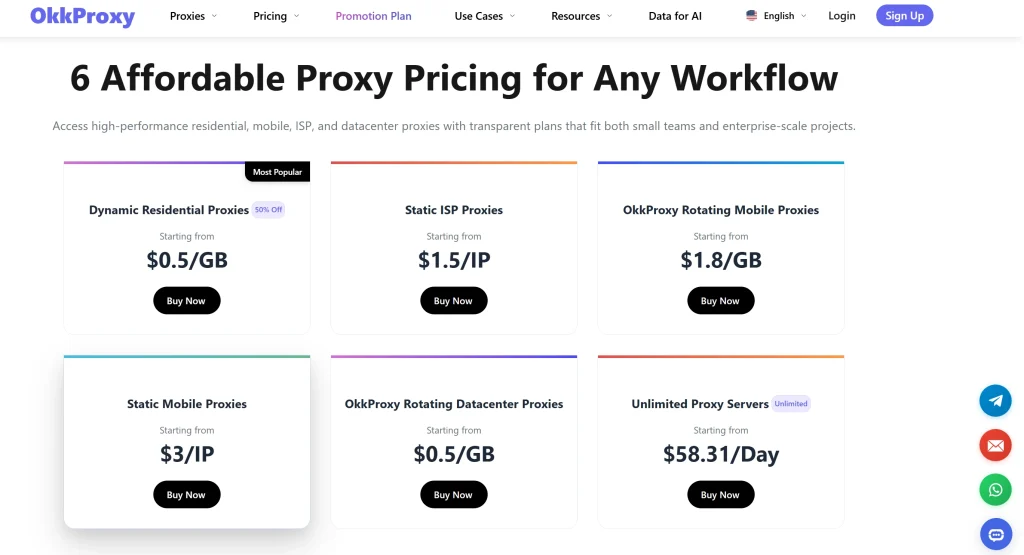
When transitioning from local testing to large-scale data harvesting across thousands of business listings, relying on a single IP address leads to rate limiting. To successfully scrape Yelp data at scale, pairing your Python pipeline with high-purity proxies is essential.
OKKProxy offers a portfolio of specialized proxy products tailored for different web scraping requirements and session conditions.
| OKKPROXY ENTERPRISE NETWORK ARCHITECTURE | |
| Rotating Residential Proxies | High-Volume SERP & Review Extraction |
| Static ISP Proxies | Sticky Session Crawling & Business Audits |
| Rotating Mobile Proxies | Restricted Endpoint Traversal & App APIs |
| Static Mobile Proxies | Persistent Geo-Localized Multi-Account Ops |
| Rotating Datacenter Proxies | High-Speed Directory Discovery & Pre-Crawl |
1. Rotating Residential Proxies
- Core Application: High-volume yelp review scraper execution, SERP crawling (scrape yelp search), and automated data pipelines.
- Technical Advantage: Accessing over 80 million real residential IPs worldwide, OKKProxy automatically rotates your exit IP with every request or sticky interval. Because requests appear to originate from legitimate home internet service providers (such as Comcast, AT&T, or Spectrum), target firewalls rarely flag traffic.
- Learn more in our comprehensive Rotating Residential Proxies Practical Guide.
2. Static ISP Proxies
- Core Application: Long-lived sticky sessions, continuous business metadata extraction, and multi-step account management workflows.
- Technical Advantage: Static ISP proxies combine the high speed of datacenter hosting infrastructure with residential ASN registration. This allows scrapers to maintain a single IP for extended sessions without triggering verification checks. Discover how to calculate capacity in our guide on Choosing the Right Static Proxy Capacity.
3. Rotating & Static Mobile Proxies (4G/5G)
- Core Application: Bypassing strict security barriers, anti-bot challenges, and mobile app endpoint scraping.
- Technical Advantage: Mobile cellular IPs (CGNAT) are shared by thousands of real mobile devices simultaneously. Websites avoid blocking mobile IP pools to prevent collateral access issues for real cellular users. Read our technical breakdown on Why Mobile Proxies Feel Safer but More Unstable.
4. Rotating Datacenter Proxies
- Core Application: High-speed initial URL collection and low-cost directory indexing across unprotected web pages.
Competitive Analysis: Custom Python Scraper vs. SaaS Scraper APIs
When designing an enterprise scraping strategy, teams often choose between building an in-house Python scraper backed by OKKProxy or subscribing to managed SaaS scraping APIs (such as ScraperAPI, SerpApi, Bright Data, Scrapfly, Crawlbase, or Outscraper).
| Evaluation Metric | In-House Python + OKKProxy | SaaS Scraping API Providers |
| Cost Efficiency at Scale | High ($0.02 – $0.05 / 1k requests) | Moderate-Low ($1.50 – $5.00 / 1k requests) |
| Data Extraction Granularity | Complete Control (Custom CSS/DOM selectors) | Restricted to pre-parsed API response schemas |
| Request Throughput & Latency | Direct Connection (Low latency with curl_cffi) | Added API gateway middleware latency |
| TLS & Header Customization | Full Customization (Browser impersonation) | Closed black-box header management |
| Session Persistence Management | Granular Control (Sticky vs Rotating pools) | Fixed API session tokens |
| Resource Optimization | Highly scalable with low CPU overhead | Requires external vendor API credits |
By combining Python’s lightweight scraping stack with OKKProxy’s high-purity proxy network, businesses retain complete data ownership, reduce operational overhead, and avoid expensive per-request API pricing.
Operational Troubleshooting Checklist & Rate Limit Mitigation
Before deploying a production yelp scraper python workflow, use this operational checklist to maintain high request success rates:
- TLS Fingerprint Verification: Confirm that your HTTP requests use curl_cffi with browser impersonation enabled (impersonate=”chrome120″).
- Proxy Routing Configuration: Ensure your script routes requests through OKKProxy Rotating Residential Proxies to distribute requests across unique IP subnets.
- Dynamic Attribute Selectors: Use partial string matching (lambda c: c and “review__” in c) rather than relying on fixed CSS class names.
- Request Delay Jitter: Implement random delays (time.sleep(random.uniform(2.0, 5.0))) between requests to maintain natural crawling behavior.
- HTTP Header Alignment: Include realistic headers (User-Agent, Accept-Language, Referer) matching modern desktop browsers.
Enterprise Case Study: 2 Million Reviews Extracted at 99.4% Success
Client Profile
A digital intelligence agency required automated extraction of over 2 million Yelp customer reviews across 50 US metropolitan regions to power a local brand sentiment dashboard.
Operational Challenges
The client’s initial internal scraper ran into severe stability issues:
- 82% of HTTP requests were blocked with 403 Forbidden errors within 15 minutes of script execution.
- Shared datacenter IP addresses were quickly flagged and banned by edge security.
- Headless browser setups (Selenium/Puppeteer) consumed excessive server memory and ran too slowly to meet production deadlines.
BEFORE OKKPROXY: [18% Success Rate] [Frequent 403 Blocks] [High Compute Cost]
AFTER OKKPROXY: [99.4% Success Rate] [Zero IP Bans] [3.5x Processing Speed]
The OKKProxy Solution
- Network Infrastructure Integration: Implemented OKKProxy Rotating Residential Proxies with US geo-targeting, routing each request through a unique residential IP address.
- Scraper Pipeline Optimization: Refactored the scraping script to use curl_cffi and BeautifulSoup, eliminating headless browser overhead while maintaining valid TLS signatures.
- Sticky Session Architecture: Configured 5-minute sticky session pools for paginated business reviews, combined with dynamic IP rotation for initial search index discovery.
Key Performance Outcomes
- Request Success Rate: Increased from 18% to 99.4%.
- Extraction Throughput: Accelerated pipeline processing speed by 350%, completing the 2M review harvest in days rather than weeks.
- Infrastructure Savings: Reduced server compute costs by 45% by replacing resource-heavy headless browsers.
Frequently Asked Questions (FAQ)
What is the best way to scrape Yelp reviews using BeautifulSoup without getting blocked?
Because BeautifulSoup is strictly an HTML parsing library, it does not handle HTTP requests or TLS handshakes. To prevent IP blocks while parsing with BeautifulSoup, execute HTTP requests using curl_cffi (to pass JA3/JA4 fingerprint checks) and route traffic through OKKProxy Rotating Residential Proxies.
How much data can we scrape from Yelp?
There is no hard limit on the volume of public data you can extract from yelp.com when using proper IP rotation and request distribution. By distributing traffic across OKKProxy’s pool of over 80 million residential IP addresses, enterprise teams reliably extract millions of records daily.
Why does my Yelp scraper return HTTP 403 Forbidden errors?
An HTTP 403 status code indicates that Yelp’s anti-bot system identified your request as automated traffic. Common triggers include:
- Standard OpenSSL TLS signatures sent by basic HTTP libraries (requests, urllib).
- High request volumes sent from a single IP address or datacenter subnet.
- Incomplete or unnatural HTTP request headers.
Can I use a free yelp scraper chrome extension or GitHub script?
While free browser extensions or basic scripts on GitHub work for small, one-off tasks (extracting fewer than 50 reviews), they do not scale for production workloads. Free scripts lack automatic proxy rotation, break when Yelp updates its HTML structure, and risk getting your local IP address banned.
How do I handle Yelp menu URL structure format changes?
Yelp menu pages (/menu/…) often load content dynamically using AJAX calls. To extract menu items efficiently, inspect the browser’s Network tab to target underlying JSON endpoints, or parse embedded JSON-LD metadata tags (<script type=”application/ld+json”>) within the page source.
Conclusion & Next Steps
Scraping Yelp reviews at scale does not require expensive managed SaaS APIs or complex headless browser infrastructure. By combining curl_cffi for browser TLS impersonation, BeautifulSoup for robust HTML parsing, and OKKProxy Rotating Residential Proxies for reliable IP rotation, you can build a fast, scalable, and cost-effective web scraping pipeline.