
Quick Takeaway
In modern Search Engine Reputation Management (SERM), a robust proxy infrastructure serves as the vital foundation that empowers brands to bypass strict rate limits, mask corporate IP addresses, and extract accurate, localized Search Engine Results Pages (SERPs). Without high-quality IP rotation, automated monitoring tools face instant IP bans and distorted data from search engine anti-scraping algorithms.
Incorporating a balanced matrix of rotating residential, static ISP, and mobile proxies ensures clean, unbiased sentiment tracking, allowing digital enterprises to protect and optimize their online narrative seamlessly.
Proxies in SERM: How Proxy Infrastructure Supports Reputation Management
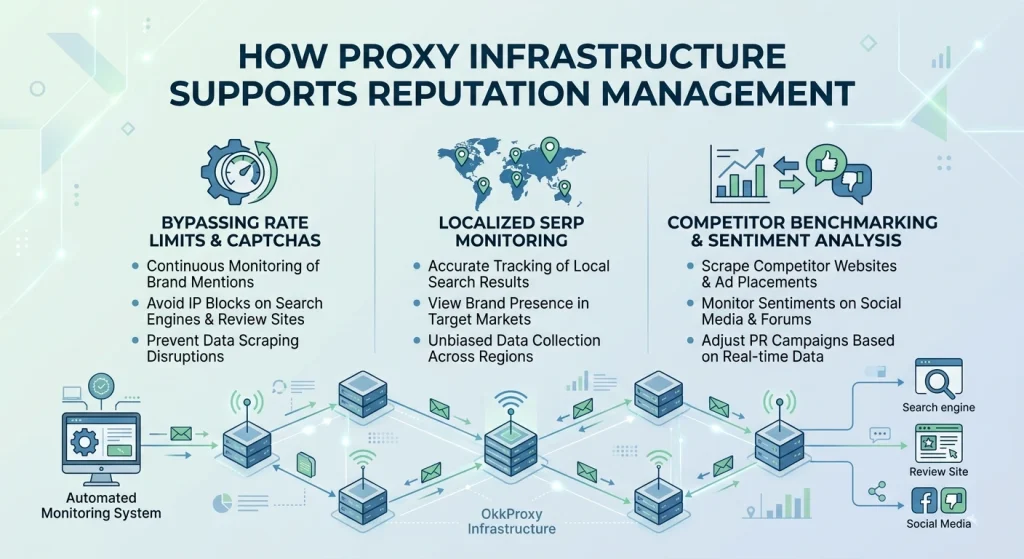
In the hyper-competitive digital ecosystem, your online narrative dictates your bottom line. Search Engine Reputation Management (SERM) is no longer just an optional PR tactic; it is a critical defensive and offensive strategy for global enterprises, SEO agencies, and digital marketers. When a potential client searches for your brand, what they see on the first page of Google, Bing, or regional review platforms determines whether they convert or abandon your funnel.
However, executing an effective SERM strategy at scale introduces severe operational bottlenecks. Constantly monitoring brand mentions, scanning thousands of localized search results, and auditing user-generated sentiment across forums triggers immediate automated defense mechanisms from major search engines. This is where a highly resilient, enterprise-grade proxy infrastructure becomes indispensable.
The Technical Workflow of Automated SERM Auditing
To successfully monitor an online narrative without interruption, data must flow through a structured, multi-layered processing system:
First, the enterprise SERM monitoring engine initializes the tracking task by generating a high volume of search queries targeting key brand terms, executive names, and product review URLs.
Second, instead of letting these requests exit directly through the corporate network, they are intercepted by the OkkProxy middleware layer. This management layer instantly filters the incoming requests, dynamically handles required rotation intervals, and optimizes routing latency.
Third, the middleware strategically distributes the requests across a specialized IP matrix depending on the target site’s security profile. High-security search pages are routed through dynamic rotating residential proxies, persistent brand management logins are directed through static ISP proxies, and mobile-first search layouts utilize targeted mobile networks.
Fourth, the requests reach their destinations—such as Google SERPs, Yelp, or Reddit—bearing completely distinct, highly trusted digital footprints. The target platforms process these requests as natural human interactions, returning raw, accurate localized data back through the proxy tunnel to the analytical dashboard.
Understanding the Core Architecture
Before diving into execution models, we must clarify the underlying technical definitions that govern this space. For teams executing data collection, understanding what occurs behind the scenes prevents costly infrastructure failures.
What is proxy infrastructure?
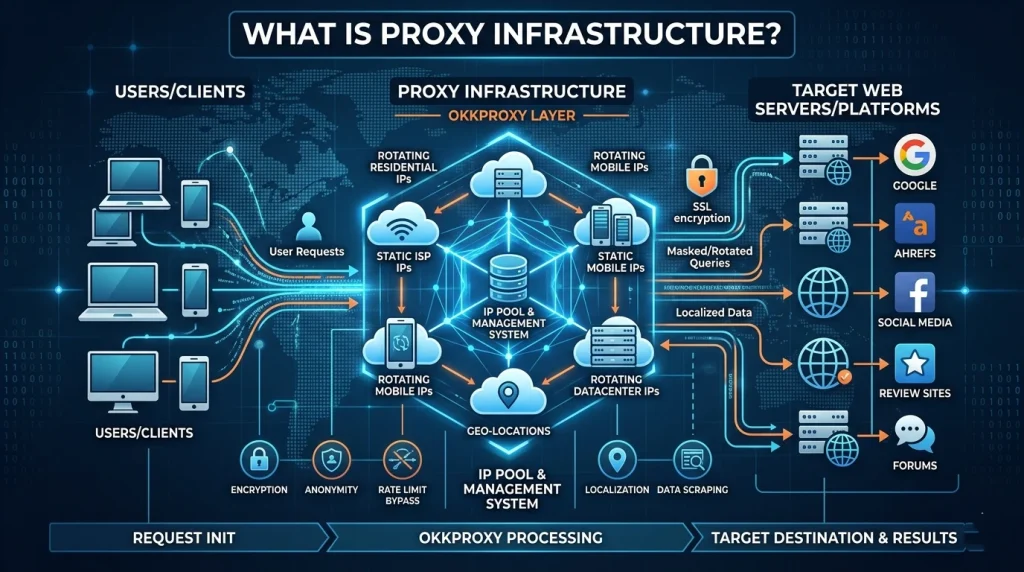
A proxy infrastructure is a comprehensive, interconnected network of proxy servers, routing protocols, and IP management systems designed to act as an intermediary layer between an automated system (such as an SEO scraper or sentiment analysis bot) and target web servers. Rather than executing requests from a single corporate data center IP, a sophisticated infrastructure dynamically routes traffic through millions of diverse, ethically sourced IP nodes globally, managing rotation, session stickiness, authentication, and fingerprint spoofing.
What is a proxies job?
Fundamentally, a proxies job is to intercept a client request, mask the original source’s IP address, replace it with an alternative IP from its own pool, and forward the request to the target destination. In a high-volume data context, its job expands significantly: it must normalize traffic, overcome geographic content blocks, solve CAPTCHAs preemptively by presenting a highly trusted user agent profile, and distribute request loads evenly to mimic human browsing behavior perfectly.
Deconstructing the Technical Framework: Typologies & Use Cases
To select the ideal solution for your reputation campaigns, you must understand the distinctions among various proxy formats.
What are the two types of proxies?
At a foundational architecture level, proxies are split into two primary operational categories:
- Forward Proxies: Positioned in front of clients to mask their identity and pass requests to public websites. This is the primary type used in data gathering, SEO auditing, and market intelligence.
- Reverse Proxies: Positioned in front of web servers to protect, load-balance, and cache data for the host website.
What are the three types of proxies?
When looking at the physical sourcing and location of IPs, the proxy industry categorizes them into three distinct types:
- Residential Proxies: Real IP addresses assigned by local Internet Service Providers (ISPs) to residential homeowners. They possess the highest trust score because they are indistinguishable from real consumers.
- Datacenter Proxies: IPs generated within massive secondary cloud servers and data hubs (e.g., AWS, DigitalOcean). They offer exceptional processing speeds and low latency but carry lower trust scores on strict platforms.
- Mobile Proxies: IPs assigned by cellular network operators (like AT&T, Verizon, or Vodafone) to actual mobile devices using 4G, 5G, or LTE infrastructure.
What are proxies used for?
In the broader digital marketing landscape, proxies are deployed for an array of business-critical operations:
- Automated Brand Auditing: Scraping Google, Bing, and DuckDuckGo dynamically to spot negative press or algorithmic changes.
- Review Platform Aggregation: Harvesting user reviews from high-security platforms like Trustpilot, Yelp, and Glassdoor without triggering rate blocks.
- Ad Verification: Ensuring localized ad campaigns display correctly across diverse markets without fraudulent interference.
- Social Listening: Aggregating real-time sentiment data from restricted API environments on X (formerly Twitter), Reddit, and Instagram.
How Proxy Infrastructure Directly Powers Reputation Management
When deploying automated systems to analyze or influence search engine results, you inevitably encounter advanced anti-bot layers like Cloudflare, Akamai, or Google’s internal reCAPTCHA engines. A robust proxy infrastructure acts as a structural shield, neutralizing these defenses through five distinct operational pathways.
1. Bypassing Severe Rate Limits and CAPTCHAs
Search engines and review platforms protect their assets by applying strict rate-limiting policies. If a single IP address sends hundreds of search queries per minute to track brand keywords, the platform instantly serves a hard IP block or an infinite loop of CAPTCHAs.
By leveraging OkkProxy’s rotating residential proxies, your automation tool can distribute its requests dynamically across a pool of millions of real user nodes. Because every individual request originates from a completely unique residential household, the target platform views the traffic as hundreds of independent human users browsing naturally.
2. Eliminating Localized SERP Drift
Search engine results are highly localized. A search for a multinational brand in Chicago will surface an entirely different set of news, reviews, and featured snippets than the exact same search executed in London or Tokyo.
If your core reputation management team operates out of a centralized headquarters, direct querying will return biased, localized data. Deploying targeted proxy nodes allows you to specify exact country, state, and city-level geolocations, guaranteeing that your SERM specialist sees precisely what local consumers see on their screens.
3. Executing Competitor Benchmarking Securely
To shift a brand’s narrative, you must reverse-engineer the digital footprints of your competitors. What PR platforms are they utilizing? Which specific backlink profiles are boosting their positive press?
Conducting deep, continuous crawls of competitor domains directly from corporate networks reveals your strategic focus and exposes your internal IPs to retaliatory blocks. Utilizing a dedicated infrastructure obfuscates your tracking operations, keeping your market research completely anonymous.
4. Continuous Social Media and Forum Scraping
A brand crisis rarely starts on Google’s front page; it usually bubbles up within community subreddits, viral X threads, or niche industry forums. Tracking these platforms requires persistent data scraping.
Because social networks enforce some of the strictest data-harvesting limitations online, relying on static or low-quality IPs will result in immediate account or network bans. Utilizing specialized mobile configurations bypasses these restrictions, as cellular networks naturally share IPs among thousands of real mobile users, making platforms highly hesitant to block them.
5. Ensuring Unbiased Data Integrity
Search engines optimize user experiences by caching historical search data and tracking browser fingerprints. If your internal marketing department checks company rankings daily, your search results will skew positive over time due to personalized behavioral bias. Utilizing clean proxy endpoints strips out these historical biases, returning objective, unfiltered SERP landscapes.
Matching Proxy Assets to SERM Deployment Stages

An enterprise reputation management strategy demands different tools for different scenarios. Deploying a single proxy type across all operations leads to either excessive budgets or high failure rates.
| Proxy Type | Trust Score | Latency/Speed | Primary SERM Deployment Use Case |
| Rotating Residential Proxies | Maximum | Moderate | High-security SERP scraping, Google rank tracking, crawling strict review platforms. |
| Static ISP Proxies | High | Low | Consistent social media account management, manual review responses, forum moderation. |
| Rotating Mobile Proxies | Maximum | Moderate | Scraping dynamic mobile-first search layouts, cross-platform social listening. |
| Static Mobile Proxies | Maximum | Low | Maintaining long-term localized mobile app presence, managing geographic profiles. |
| Rotating Datacenter Proxies | Moderate | Extremely Low | Initial bulk data harvesting on low-security domains, high-velocity indexing checks. |
Real-World Case Study: Overcoming Reputation Crises with OkkProxy
To understand the practical execution of these methods, consider a real case study handled by an enterprise partner utilizing OkkProxy’s specialized architecture.
The Challenge: Algorithmic Negative Review Cascades
A Tier-1 financial services provider experienced a coordinated negative review attack on a prominent regional business platform. Within 48 hours, a wave of automated negative reviews distorted their local search snippets across 45 major metropolitan areas, causing an immediate drop in inbound lead generation.
The client’s internal marketing agency attempted to deploy automated brand auditing scripts via standard datacenter proxies to track the velocity of these reviews and isolate the source. Within three hours, the target review platforms flagged the data center IP block, completely blacklisting the agency’s systems and serving continuous CAPTCHA walls.
The Solution: Deploying OkkProxy’s Hybrid Architecture
The agency pivoted by integrating OkkProxy’s API-driven proxy infrastructure directly into their proprietary sentiment analysis software. They structured a two-pronged deployment strategy:
- Phase 1 (The Audit): They utilized rotating residential proxies configured with strict city-level targeting across the 45 affected metro areas. This allowed their scraping engines to bypass all bot defenses, extracting clean, un-cached local search results every hour to pinpoint precisely which negative review URLs were gaining algorithmic weight.
- Phase 2 (The Remediation): To actively counter the false narratives, the brand’s support agents utilized static ISP proxies. These static IPs provided fixed, trusted digital footprints, allowing reputation managers to log directly into localized corporate accounts and post official, verified counter-evidence without triggering security flags or fraud warnings.
The Operational Evolution Timeline
The containment and resolution of the reputation crisis progressed through five distinct operational phases:
First, at hour zero, the coordinated negative review attack was discovered impacting local business listings.
Second, by hour twelve, the internal agency attempted rapid scraping using standard datacenter IPs, which resulted in instant IP bans and automated system blockages.
Third, at hour twenty-four, the agency completed the integration of OkkProxy’s system and activated a highly targeted city-level rotating residential pool.
Fourth, within thirty-six hours, data gathering hit a one hundred percent success rate, establishing real-time localized SERP visibility across all targets.
Fifth, by hour forty-eight, static ISP proxies were fully deployed, enabling global support teams to securely log into platforms, resolve claims, and systematically neutralize false reviews over the following week.
The Strategic Results
By routing their workflows through a clean, diversified IP matrix, the agency eliminated all data collection blocks. They successfully gathered the necessary data points to submit formal takedown notices, systematically pushed the negative results down the SERPs, and restored the client’s local star ratings back to baseline levels within 7 business days.
What is a good practice for managing online reputation?
Successful reputation management combines advanced technical tools with clear, human-centric workflows. When establishing your SERM framework, implement this definitive checklist to guarantee consistent, safe data extraction.
The Ultimate SERM Infrastructure Checklist
- Incorporate Dynamic User-Agent Rotation: Always pair your rotating residential IPs with a corresponding database of updated, real-world browser headers and user-agent strings. Match mobile IPs exclusively with mobile user-agents.
- Establish Sticky Sessions for Manual Moderation: When logging into brand profiles to respond to user complaints, utilize static ISP or static mobile proxies to maintain a consistent IP session for at least 30 minutes, preventing security blocks.
- Distribute Query Loads Randomly: Avoid running scrapers on rigid intervals (e.g., exactly every 60 seconds). Introduce random human delays (“jitter”) between your requests to minimize behavioral patterns.
- Geolocate Queries Precisely: Align your proxy’s target location with your key consumer demographics. Do not query Texas localized search terms using a European network node.
- Monitor IP Health Proactively: Utilize live dashboard metrics to track success-to-failure ratios. If a specific subnet drops below a 98% success rate, automatically cycle it out of the active rotation pool.
Deep-Dive Technical Q&A: Optimizing Your Proxy Architecture
What is the concept of reputation management?
The core concept of reputation management (and more specifically, SERM) revolves around actively monitoring, influencing, and shaping the public perception of an entity—be it a corporation, executive, or individual—across digital search channels. It focuses heavily on maximizing the visibility of positive, controlled content while systematically suppressing inaccurate, harmful, or defamatory links to lower pages of search results where user click-through rates drop below 1%.
Why are datacenter proxies risky for direct Google SERP monitoring?
While datacenter proxies offer exceptional network speeds and very low operating costs, their IP ranges belong to commercial data hubs. Search engines realize that normal consumers do not browse the web from an AWS data center. Consequently, these IP blocks are pre-flagged with lower trust scores. Using them for intensive SERP scraping triggers aggressive anti-bot screens almost instantly. For resilient tracking, they should be used to scrape lower-security sites, while residential or mobile nodes handle search engine indexing pages.
How do rotating mobile proxies manage to bypass strict platform firewalls?
Mobile proxies operate on cellular networks that utilize Carrier-Grade NAT (CGNAT) technology. Because cellular providers have fewer IPv4 addresses than active mobile devices, thousands of real mobile users frequently share the same public IP address simultaneously. Security networks recognize this dynamic; if a platform blocks a single mobile IP address due to aggressive bot behavior, it risks inadvertently blacklisting thousands of legitimate consumers. This makes platforms highly hesitant to ban mobile IP ranges, granting mobile configurations exceptional pass rates.
The Strategic Takeaway
Strategic Takeaway: Modern SERM is an arms race of data extraction and sentiment tracking. Relying on basic, unmanaged corporate networks or low-tier shared proxies leaves your digital monitoring efforts vulnerable to data blind spots and continuous IP bans. To protect your brand’s digital presence at scale, you must deploy a reliable, multi-tiered proxy infrastructure that blends the sheer velocity of datacenter nodes, the absolute authority of rotating residential IPs, and the persistent stability of static ISP networks.
Ready to bulletproof your brand’s data extraction strategy? Explore OkkProxy’s premium proxy solutions to establish a highly reliable, compliant, and enterprise-grade IP infrastructure tailored for your digital marketing success.
Additional Insights & Technical Resources
To expand your team’s technical expertise in web automation, web scraping compliance, and advanced SEO monitoring configurations, check out these deep-dive guides:
- How IP Rotation Improves Success Rates in Mobile Automation Tasks?
- Enterprise Proxy Guide: Native IP vs Broadcast IP Comparison Explained
- HTTP vs HTTPS Proxy: Key Differences and Best Use Cases
- Dynamic Residential Proxies: Proven Ways to Win Limitless Ad Verification in 2026
- Why Websites Keep Asking If You’re a Robot (And How to Stop It)