Quick Summary:
An open proxy is a publicly accessible server that allows anyone to route internet traffic without authentication. While “free,” they are fundamentally insecure. Users often face data theft, malware injection, and frequent IP flagging. For professionals in SEO, web scraping, and account management, the answer to “Is an open proxy safe?” is a resounding no.
To ensure stability and security, expert-grade solutions like OkkProxy’s rotating residential proxies are required to protect your data and maintain high success rates.
Is an Open Proxy Safe? The Truth Behind Free Servers
In the world of digital marketing and data extraction, the temptation to use “free” resources is high. You might have stumbled upon lists of public IP addresses and wondered, is an open proxy safe for my business operations?
At OkkProxy, we work with SEO professionals and data analysts every day who have learned the hard way that “free” usually comes with a hidden, expensive price tag. Whether you are performing rank tracking or managing social media accounts, understanding the architecture of an open proxy is the first step toward protecting your digital assets.
What is an Open Proxy?
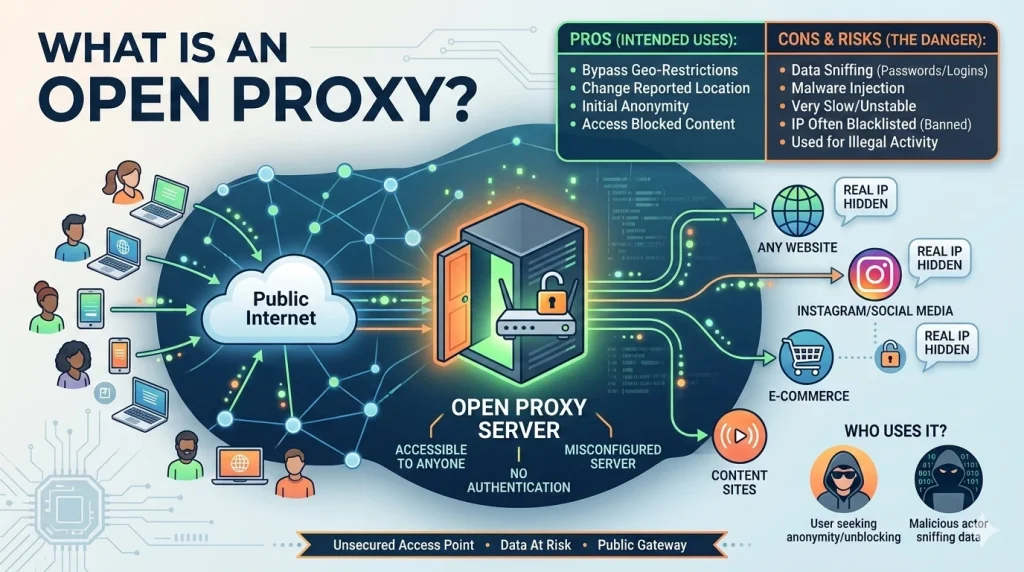
An open proxy is a proxy server that is accessible by any internet user. Unlike a closed proxy, which requires authentication (like a username or IP whitelisting), an open proxy accepts connections from everyone. These are often the result of misconfigured servers or are intentionally set up as “honeypots” by malicious actors to intercept user data.
The Comparison: Open Proxy vs. Professional Proxies
| Feature | Open Proxy | OkkProxy Residential Proxies |
| Security | None (High risk of sniffing) | End-to-end Encryption |
| Success Rate | Low (Frequent 403/429 errors) | 99.9% Success Rate |
| Speed | Slow & Unstable | High-speed Global Backbone |
| IP Reputation | Frequently Blacklisted | Clean, Residential/ISP IPs |
| Support | None | 24/7 Technical Assistance |
7 Hidden Risks of Using an Open Proxy
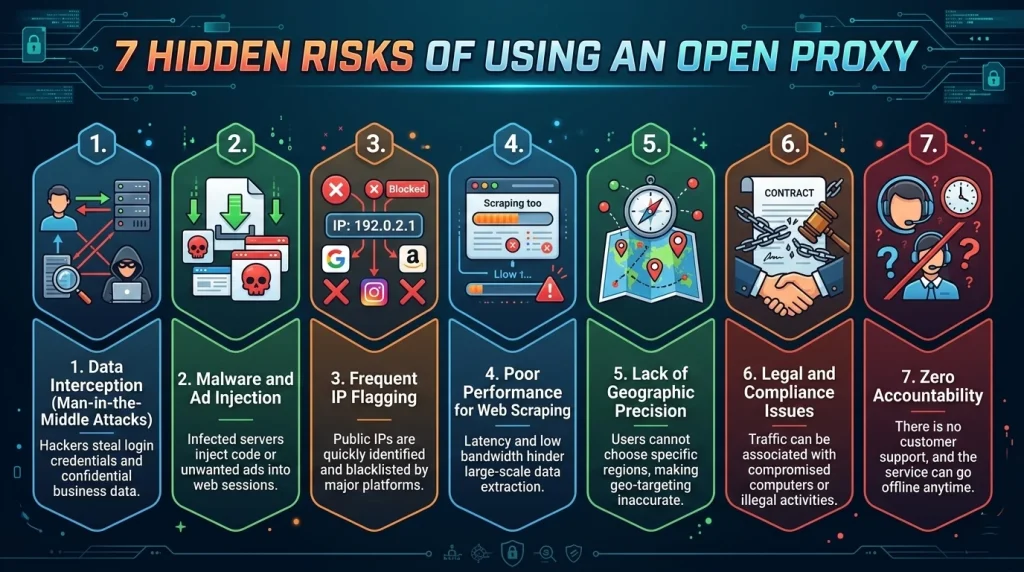
To answer the question, is an open proxy safe, we must look at the technical vulnerabilities these servers introduce to your workflow.
1. Data Interception (Man-in-the-Middle Attacks)
The owner of an open proxy can see every byte of data you send. This includes sensitive login credentials, API keys, and proprietary scraping logic. For an SEO agency, this could mean leaking client data or strategy.
2. Malware and Ad Injection
Many open proxies are set up to inject malicious code into the HTML of the websites you visit. They might replace legitimate ads with phishing links or attempt to install spyware on your machine.
3. Frequent IP Flagging
Because thousands of people use the same open proxy IP address, these IPs are almost immediately flagged by Google, Amazon, and social media platforms. If you are asking, “Why is my IP flagged as an open proxy?”, it’s likely because you’ve shared a connection with a botnet.
4. Poor Performance for Web Scraping
Open proxies are notoriously slow. If you are trying to conduct large-scale market research, the latency and high failure rates will compromise your data accuracy.
5. Lack of Geographic Precision
Most open proxies don’t allow you to choose a specific city or ISP. If you need to verify ads in London or check SERPs in New York, an open proxy won’t provide the granular targeting available with OkkProxy’s static ISP proxies.
6. Legal and Compliance Issues
Using an open proxy often means your traffic is routed through compromised “zombie” computers. This can lead to legal complications if your business traffic is associated with illegal botnet activity.
7. Zero Accountability
When an open proxy goes down—and they always do—there is no one to call. For businesses relying on uptime, this instability is a deal-breaker.
How to Identify and Turn Off Open Proxies
If you find that your connection is sluggish or websites are blocking you, you might be asking: “Am I using an open proxy?” or “How to get rid of open proxy settings?”
Checklist: Is Your IP Flagged?
- Do you see frequent CAPTCHAs on Google?
- Are you unable to access Instagram or TikTok via your current connection?
- Does an IP lookup tool label your address as “Public Proxy” or “DCH”?
- Is your connection speed significantly slower than your ISP’s advertised speed?
How to turn off open proxy:
- Windows: Go to Settings > Network & Internet > Proxy. Ensure “Use a proxy server” is toggled OFF.
- macOS: Go to System Settings > Network > [Your Connection] > Details > Proxies. Uncheck all active proxy protocols.
- Browser: Check your Chrome or Firefox extensions. Many “Free VPN” extensions act as open proxies.
Why Professionals Choose OkkProxy Over Open Proxies
To maintain a competitive edge, you need infrastructure that is stable, fast, and, most importantly, secure. Is an open proxy safe for enterprise use? Never. Here is how we provide a better alternative:
Rotating Residential Proxies for Reliable Scraping
Our rotating residential proxies draw from a pool of millions of real home user IPs. This ensures that your requests look like organic traffic, allowing you to bypass even the toughest anti-bot systems without being flagged.
Static ISP Proxies for Account Management
Managing multiple social media or e-commerce accounts requires a consistent identity. Our static ISP proxies provide the stability of a data center with the high trust score of a residential provider.
Mobile Proxies for High-Trust Tasks
For platforms like Instagram or TikTok, rotating mobile proxies and static mobile proxies are the gold standard. They utilize 4G/5G connections that are rarely blocked by social media algorithms.
Rotating Datacenter Proxies for Speed
When speed is your priority and the target site has lower security, our rotating datacenter proxies offer unparalleled throughput at a fraction of the cost.
FAQ: Understanding Open Proxy Risks
What is an open proxy on Instagram?
Instagram uses advanced detection to find users on shared, low-quality IPs. An “open proxy” warning on Instagram usually means your IP has been flagged for bot-like behavior. Switching to a static mobile proxy usually resolves this instantly.
Why is my IP address an open proxy?
Your IP might be flagged if your router’s security settings are too low, allowing others to use your connection as a relay. Ensure your UPnP settings are managed and your firmware is updated.
What is the difference between open and closed proxy?
An open proxy is public and unauthenticated. A closed proxy (like those from OkkProxy) is private, requires a subscription, and offers guaranteed security and speed.
Final Takeaway: Security is Not an Option
So, is an open proxy safe? The technical evidence and industry experience all point to “No.” For any task that involves business data, account longevity, or accurate SEO results, an open proxy is a liability.
By investing in a professional proxy provider, you aren’t just buying an IP address; you are buying peace of mind, data integrity, and the ability to scale your operations without fear of being blocked.
Ready to upgrade your proxy infrastructure?
Get started with OkkProxy today and experience the difference of premium IP quality!