When it comes to proxy services, the size of the IP pool is not just a technical detail — it’s a critical factor that directly impacts proxy performance, reliability, and anonymity. Whether you rely on residential proxies, datacenter proxies, or a hybrid setup, the number of available IP addresses can make or break your workflow.
1. Why IP Pool Size Matters
A larger proxy pool gives you more IPs to rotate, which provides several concrete advantages. As noted by proxy service experts, a big pool helps disperse traffic, reduce the risk of blocking, and maintain high request success rates.
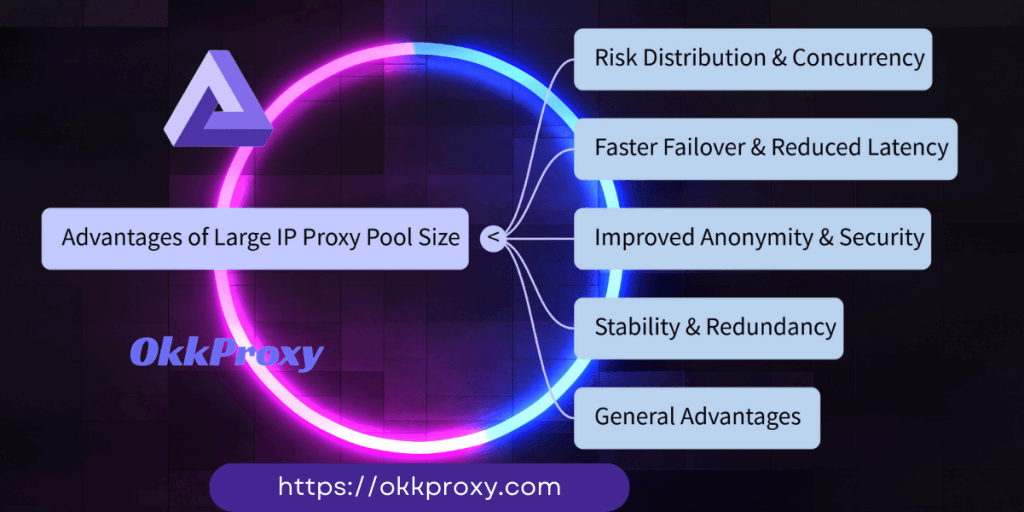
Risk Distribution & Better Concurrency
When your IP pool is small, many requests may reuse the same IPs, which increases the chance of being blocked or throttled. On the other hand, a large pool spreads outgoing requests over many addresses, reducing the pressure on individual IPs. This balancing act improves concurrency and makes the proxy service more scalable for use cases like web scraping or data mining.
Faster Failover & Reduced Latency
If one IP in your pool gets blocked or experiences slow response times, a healthy IP pool lets the system switch seamlessly to other IPs. That means less downtime, faster fallback, and a smoother user experience.
Improved Anonymity & Security
With a diverse and large IP pool, especially one spread across different geographic regions, you can disguise your true identity better. Rotating IPs lowers reuse rate, making it harder for destination sites to recognize and blacklist you.
Stability & Redundanc
Large proxy pools also contribute to better reliability. If some IPs in the pool go offline or become unstable, the system can route traffic through other healthy IPs — a form of load balancing that avoids single-point failures.

2. Quality Over Quantity: What Really Matters
While “more IPs” often seems universally better, the performance gains aren’t just about raw pool size. Other factors are equally important:
IP Quality & Cleaning Mechanism: A big IP pool is less useful if many of the IPs are low-quality — flagged, blacklisted, or slow. What makes a proxy provider reliable is not just how many IPs they claim, but how well they refresh and maintain that pool.
Geographic Distribution: An IP pool with addresses from a variety of countries helps when you need to simulate users from specific regions. Geographic diversity in the pool improves both anonymity and performance, since latency tends to be lower when the proxy exit is physically closer to your target.
Rotation Mechanism: How often and how intelligently the IPs are rotated is as critical as how many IPs there are. Efficient rotation algorithms help avoid overusing certain IPs, which reduces the chance of bans and improves request success.

3. Practical Impacts for Different Proxy Use Cases
Web Scraping / Data Collection
For large-scale web scraping, a large IP pool (datacenter or residential) is vital. By rotating IPs frequently across a big pool, crawlers can maintain high request success rates and avoid triggering anti-scraping defenses.
Multi‑Account Management & High‑Trust Operations
When managing sensitive tasks like logging into e-commerce or social media accounts, residential proxy pools with high-quality IPs reduce the chance of platform bans. A large, stable pool improves reliability and ensures that sessions remain consistent.
High-Concurrency Workloads
Businesses operating with many parallel threads (such as automation tools or bots) benefit significantly from a larger IP pool. It supports more concurrent connections without overloading individual IPs, which ensures faster response times and less risk of blockage.
4. Choosing the Right Pool Size Strategy
Here are some guiding principles when evaluating a proxy provider’s IP pool:
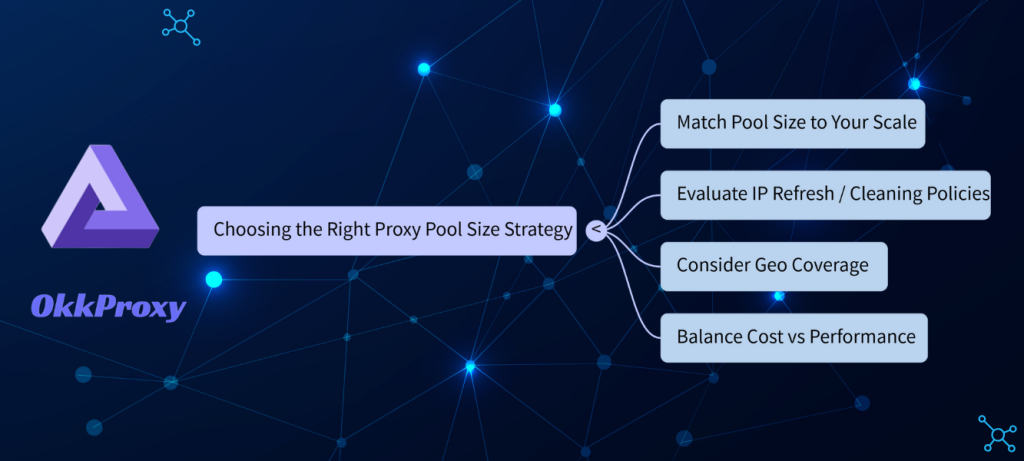
Match Pool Size to Your Scale
Estimate your maximum concurrent traffic and choose a proxy plan with enough IPs to support that. If your tasks require many simultaneous connections, prioritize providers with large, well-maintained pools.
Evaluate IP Refresh / Cleaning Policies
Ask how the provider maintains its pool: Do they purge banned IPs? How frequently do they add new ones? A robust refresh policy often trumps raw pool size.
Consider Geo Coverage
If your use case requires specific regions, look for providers whose IP pools have geographic diversity. Geographic targeting matters for legitimacy and latency.
Balance Cost vs Performance
Bigger pools generally cost more. Calculate your ROI by weighing improved proxy performance, request success, and lower ban rates against the provider’s pricing structure.
5. FAQ – How IP Pool Size Affects Proxy Performance
Q1: Why does IP pool size matter for proxy performance?
A1: A larger IP pool gives a proxy network more unique IP addresses to rotate, which helps reduce the chance of blocks, improves anonymity, and increases request success rates. With more available IPs, traffic is better distributed, leading to higher stability and faster performance.
Q2: What problems can occur if the IP pool is too small?
A2: Small IP pools often cause repeated use of the same IPs, resulting in higher block rates, unstable response times, and limited concurrency. This is especially problematic for web scraping, automation, or any use case requiring high-volume requests.
Q3: Is a larger IP pool always better?
A3: Not necessarily. While a large IP pool is beneficial, IP quality matters more. An oversized pool with many low-quality or flagged IPs can still result in poor proxy performance. A well-maintained pool with active cleaning, healthy rotation, and good geographic distribution performs better than a large but unoptimized one.
Q4: How do I choose an appropriate IP pool size for my project?
A4: Consider your concurrency needs, the target websites’ anti-bot strictness, and your traffic volume. High-frequency scraping or multi-threaded workflows require a larger IP pool. You should also check the provider’s IP rotation strategy and whether their pool includes the geographic regions you need.
Q5: What types of use cases require a larger IP pool?
A5: Large IP pools are essential for:
- Web scraping & data mining (to avoid bans and diversify requests)
- High-concurrency automation (to distribute load across many IPs)
- Multi-account management (to maintain unique, undetectable identities)
- Ad verification & SERP monitoring (to reduce detection risk)
Q6: Does IP pool size affect residential proxies and datacenter proxies differently?
A6: Yes. Residential proxies benefit from large pools for maximum anonymity and natural IP diversity, while datacenter proxies use large pools mainly to support scaling and avoid rate limits. Both types see better performance when the pool is large and well-maintained.
Q7: How can I evaluate a proxy provider’s IP pool quality?
A7: Look at these criteria:
- IP refresh and cleaning frequency
- Success rate and stability under load
- Geographical distribution of IPs
- Rotation mechanism (session-based or request-based)
- Total pool size compared to your concurrency needs
A trustworthy provider should offer transparent metrics and a well-balanced combination of pool size, IP quality, and rotation logic.
6. Conclusion
The size of the IP pool in a proxy service is much more than a number — it’s a driver of performance, anonymity, concurrency, and stability. A larger and well-maintained pool helps distribute risk, speeds up failovers, and supports high-volume tasks. But pool size alone isn’t enough; IP quality, geographic spread, and rotation strategy are equally important.
When choosing a proxy provider for serious use — whether data scraping, multi-account management, or automation — evaluate not just how many IPs they offer, but how they manage and rotate that pool. A smart, scalable IP pool strategy can significantly boost your proxy performance, minimize bans, and make your workflows more resilient.
🌍 Sign up at OkkProxy today and experience fast, secure, and reliable global proxy connectivity.