In the ultra-competitive world of modern SEO, accurate, consistent, and location-specific rank tracking is no longer optional — it’s a core requirement. Yet search engines like Google, Bing, and Baidu aggressively fight automated queries with rate-limiting, CAPTCHAs, personalized results, and outright IP bans. This is where SEO proxies (also called rank tracking proxies or SERP proxies) become indispensable.
By routing your requests through different IP addresses in different geographic locations, the best SEO proxies let you see exactly what real users see — without triggering blocks, without personalized bias, and without exposing your real identity.
In this guide, we’ll explore exactly how proxies help with SEO monitoring and rank tracking, why they’re essential in 2025, and how to choose the right SEO proxy service for accurate, scalable results.
In addition to combating blocks and CAPTCHAs, one of the biggest advantages of using proxies for rank tracking is consistency — especially when tracking large sets of keywords over time. Search engines deliver highly personalized results based on past searches, IP history, and device type, which can skew ranking data if you rely on a single IP or location. By routing traffic through dedicated proxies for rank tracking, SEO professionals can collect clean, unbiased SERP data that reflects true organic performance in separate markets, making trend analysis and monthly comparisons far more accurate.

What Are SEO Proxies and Why Do You Need Them?
An SEO proxy is a server that acts as an intermediary between your rank-tracking tool (or custom script) and search engines. Instead of sending requests directly from your office or server IP, every query goes through a proxy IP — usually a residential proxy, backconnect rotating proxy, or datacenter proxy located in the target country or city.
The biggest problems without proxies:
- Google shows personalized results based on your past searches and location
- Too many requests from one IP → CAPTCHA or error 1015 / 429 / 403
- You can’t see local SERPs in Paris, Mumbai, São Paulo, or Tokyo accurately
- Competitors (or Google) can detect that you’re spying on them
- Your main IP gets temporarily or permanently banned
Best SEO proxies solve all of the above.
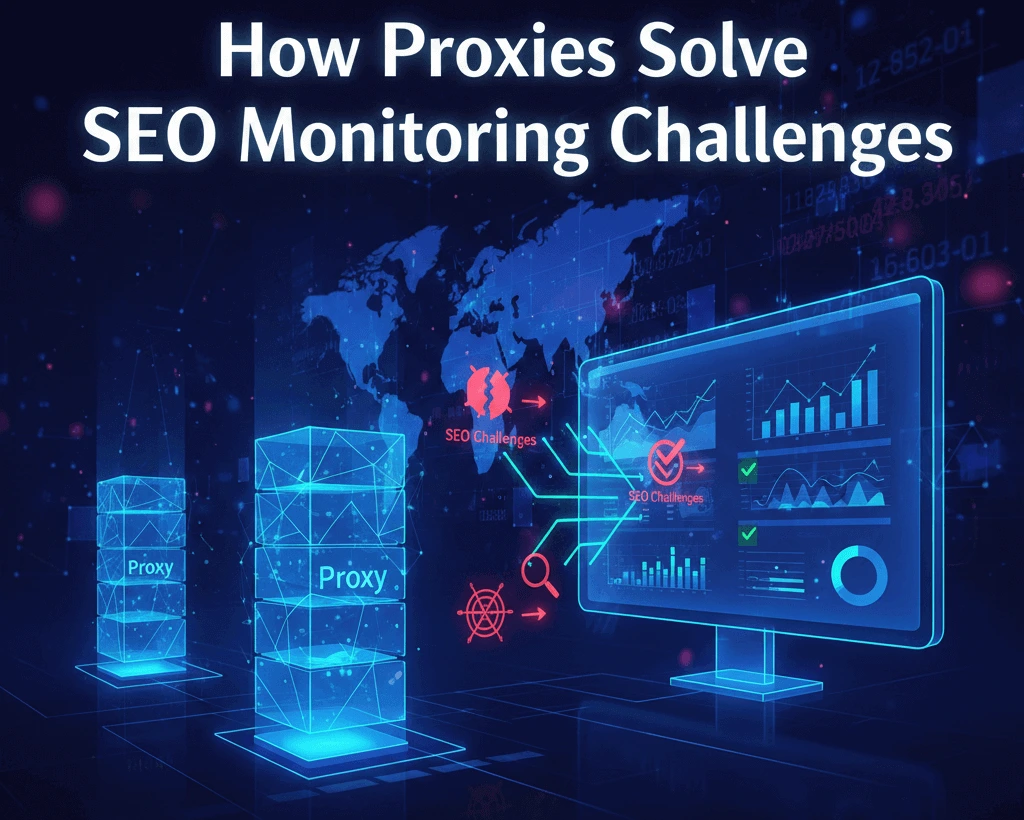
How Proxies Solve the Top 5 SEO Monitoring Challenges
1. Accurate Localized Rank Tracking (Geographic Precision)
Google serves dramatically different results depending on where the user is located — even down to the city level.
Example: The keyword “best pizza” ranks completely differently in Chicago vs New York vs Los Angeles.
With local proxies (e.g., proxy India, proxy France, proxy Brazil, Germany proxies, Australian web proxy, proxy Israel, proxy Indonesia, etc.), you can check rankings exactly as a real user in that location would see them.
This is critical for:
- Local SEO clients
- International SEO campaigns
- E-commerce stores with geographic pricing
- Franchise businesses
Tools like Ahrefs, SEMrush, and RankTracker all support proxy integration precisely for this reason.
2. Avoiding Rate Limits and IP Bans
Google allows only a handful of searches per minute from a single IP before showing CAPTCHAs or blocking you entirely.
When you’re tracking 5,000+ keywords daily across 50 locations, that’s impossible without proxies.
Rotating proxies (especially residential backconnect proxies) automatically change your IP after every request or every few requests. Popular options include:
- Bright Data (formerly Luminati) residential proxy network
- Oxylabs residential proxies
- Smartproxy
- SOAX
- NetNut
- IPRoyal
- StormProxies
These services give you access to millions of real residential IPs, making it virtually impossible for Google to detect automation.
3. Getting Unbiased, Non-Personalized SERPs
Even in incognito mode, Google personalizes results based on your rough location and past behavior.
With a clean residential proxy from a different country, you get “neutral” results — exactly what a brand-new visitor would see.
This is essential for:
- Competitor analysis
- Baseline ranking reports
- Before/after algorithm update comparisons
4. Competitor Monitoring Without Detection
Want to see what ads your competitors are running in France? Or how their snippet looks in India?
Using your real IP (or even a single static proxy) leaves footprints.
High-quality SEO proxy services with rotating residential IPs make every request appear as a different real user — total anonymity.
5. Scaling Automated Rank Tracking Safely
Modern rank trackers (RankTracker, AccuRanker, SERPWatcher, Wincher, ProRankTracker, etc.) all support proxy rotation.
You can set up:
- One proxy per country
- Backconnect rotating nodes
- Sticky sessions (same IP for 10–30 minutes for consistency)
This allows fully automated, daily (or hourly) rank checks at scale — without ever touching your main IP.
Another core benefit of proxies for rank tracking is their role in geo-specific keyword insights. Search engines return significantly different result pages depending on the visitor’s location — even at the city level — and that geographic variance can make or break localized SEO strategies. Proxies enable you to simulate searches from exact regions, allowing rank tracking tools to pull the exact rankings users see in countries like India, France, Brazil, or cities such as London or Sydney. This ensures your keyword performance reports are genuinely representative of target audiences rather than filtered through your own IP footprint.
Types of Proxies Used for SEO Monitoring & Rank Tracking
| Type | Best For | Pros | Cons |
| Residential Proxies | Most accurate local SERPs | Real user IPs, lowest block rate | More expensive |
| ISP Proxies | Long sessions + residential trust | Fast, stable, harder to detect | Slightly pricier than datacenter |
| Rotating Backconnect | High-volume automated tracking | Auto-rotates IPs, huge pools | Need sticky sessions sometimes |
| Datacenter Proxies | Budget tracking | Cheap, very fast | Higher ban rate on Google |
| Mobile Proxies (4G/5G) | Hyper-local + mobile rankings | Extremely hard to block | Most expensive |
For 99% of serious SEO professionals, residential rotating proxies or ISP proxies are the gold standard.
Using proxies for rank tracking also improves how automated SEO tools handle large workloads safely. Modern rank trackers like AccuRanker, SERPWatcher, and RankTracker support proxy configuration precisely because sending thousands of queries from a single address quickly triggers search engine defenses. With properly configured proxies, each request can come from a different, clean IP, allowing daily or even hourly automated rank checks without breakdowns, throttling, or blocked data streams. This level of scalability is essential for agencies and enterprises monitoring hundreds or thousands of keywords.
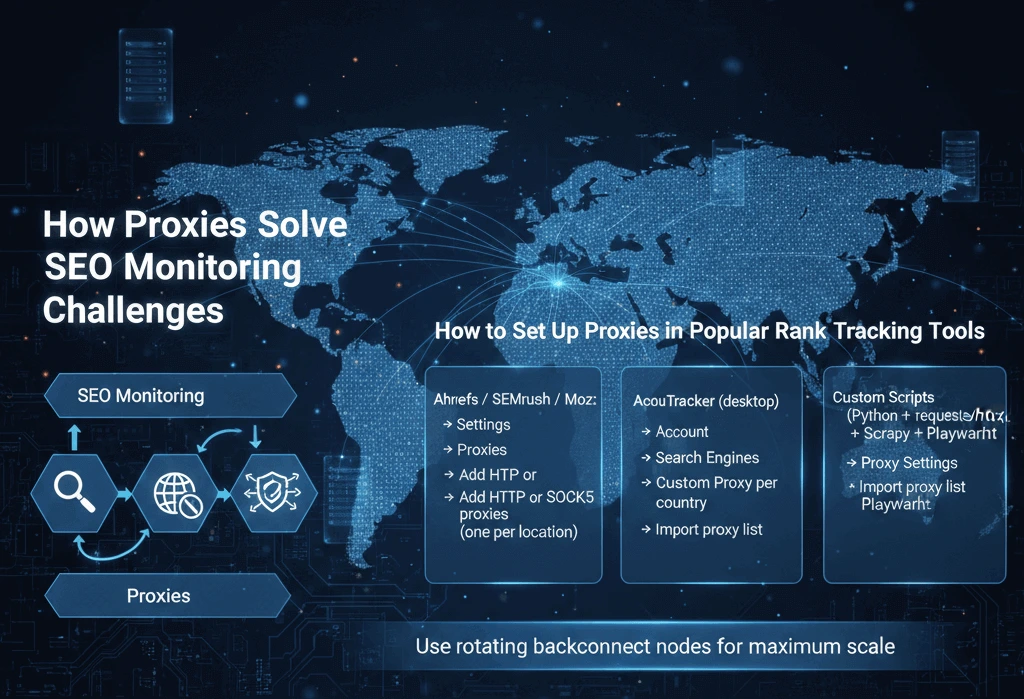
How to Set Up Proxies in Popular Rank Tracking Tools
Ahrefs / SEMrush / Moz→ Settings → Proxies → Add HTTP or SOCKS5 proxies (one per loction)
AccuRanker→ Account → Search Engines → Custom Proxy per country
RankTracker (desktop)→ Preferences → Proxy Settings → Import proxy list
Custom Scripts (Python + requests/httpx + Scrapy + Playwright) use rotating backconnect nodes for maximum scale.
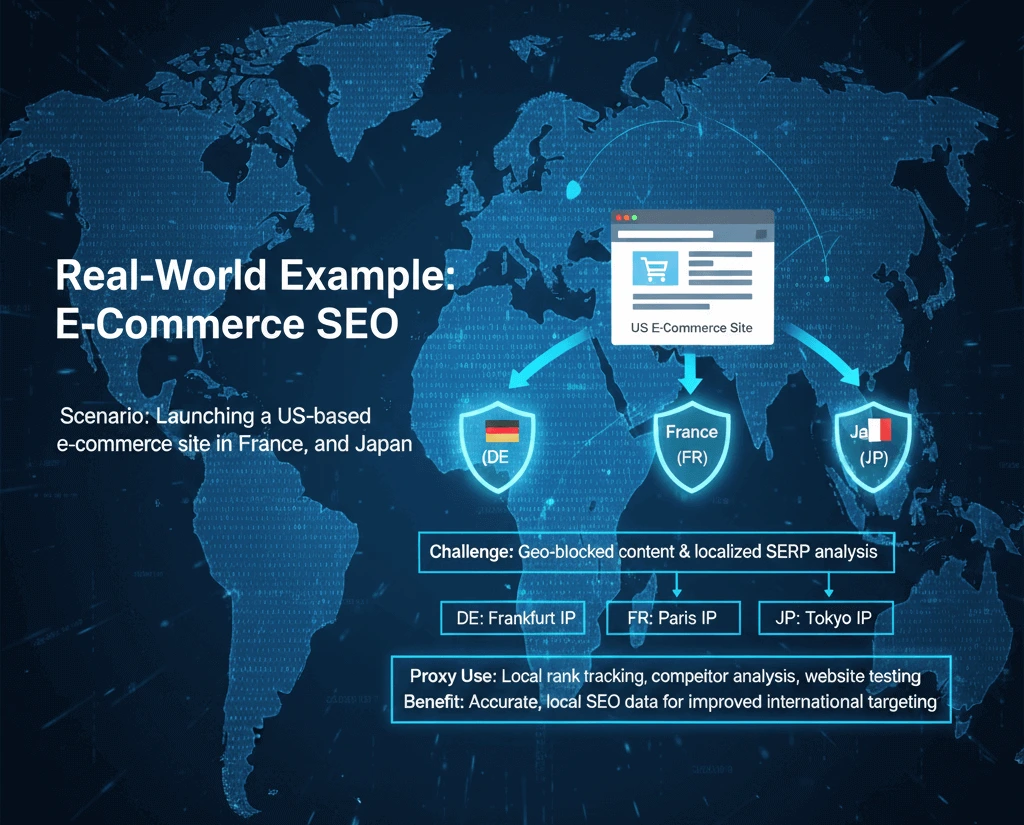
Real-World Example: International E-Commerce SEO
A client sells fashion online in 15 countries. They need daily rank tracking for 8,000 keywords across all markets.
Without proxies: Impossible — Google blocks after 50 searches.
With residential rotating proxies:
- 1 backconnect node per country (France proxy, proxy India, proxy Brazil, Germany proxies, etc.)
- 500–1000 requests per node per day
- Zero CAPTCHAs
- 100% accurate local rankings
- Full competitor SERP snapshots
Result: They discovered #1 rankings in Germany were slipping due to a competitor’s aggressive featured snippet strategy — and fixed it within weeks.
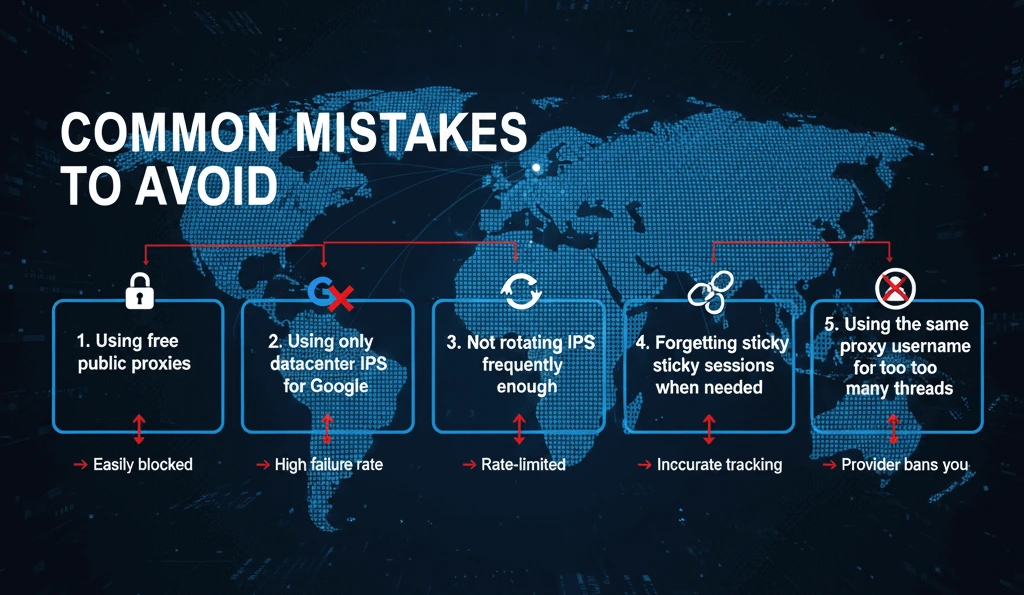
Common Mistakes to Avoid
- Using free public proxies →Easily blocked
- Using only datacenter IPs for Google → High failure rate
- Not rotating IPs frequently enough → Rate-limited
- Forgetting sticky sessions when needed → Inaccurate tracking
- Using the same proxy username for too many threads → Provider bans you
Ultimately, prioritizing proxies for rank tracking is not just about avoiding blocks — it’s about trustworthy SEO insights. Accurate rank data forms the backbone of content planning, competitor research, and performance forecasting. When your keyword rankings are measured through untampered, location-specific, anonymous requests, you gain a clearer picture of real search performance and user behavior, enabling smarter strategic decisions and better outcomes across campaigns.
Final Thoughts: Proxies Are Now Table Stakes for Serious SEO
In 2025, if you’re doing international or local SEO at any serious scale — whether for your own sites or clients — you cannot rely on manual checks or single-IP tools.
The best SEO proxies give you:
- Pinpoint geographic accuracy
- Complete anonymity
- Freedom from blocks and CAPTCHAs
- Clean, unbiased SERP data
- The ability to automate and scale safely
Investing in a quality SEO proxy service (even $100–300/month) pays for itself many times over through better data, faster decisions, and higher rankings.
Start using SEO proxies today — your rankings (and your clients) will thank you.