Summary
The chrome-error://chromewebdata/ message is a Chromium fallback that appears when a webpage fails to load due to network interruptions, DNS conflicts, or proxy handshake timeouts. For SEO professionals and data analysts, this error often signals a deeper issue with IP reputation or connection stability.
This guide provides a verified 7-step methodology to resolve the error, specifically highlighting how high-quality network infrastructure—like rotating residential proxies—can prevent these interruptions in high-stakes environments like web scraping and account management.
What Exactly is the chrome-error://chromewebdata/ Message?
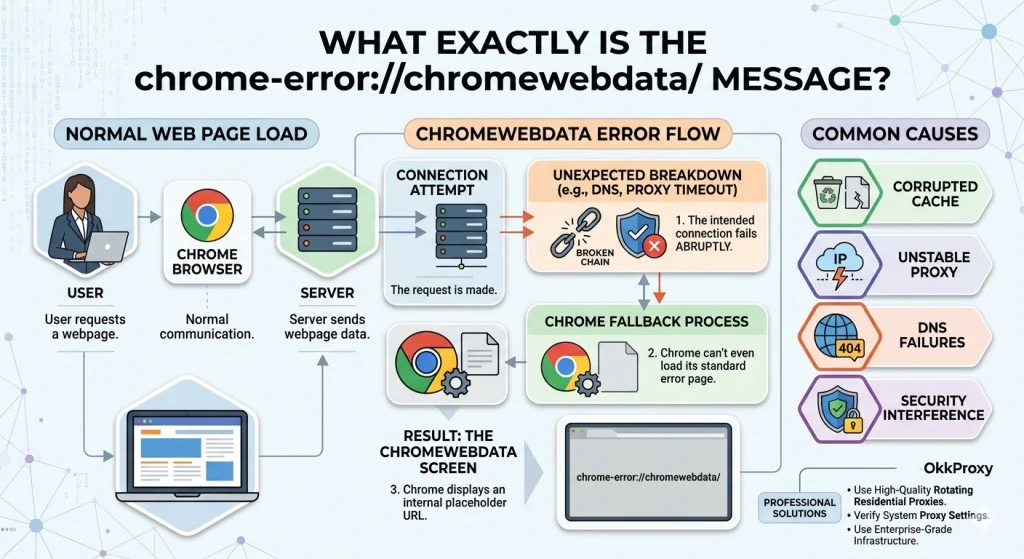
If you are a digital marketer or a data scientist, you have likely encountered the frustrating chrome-error://chromewebdata/ screen. Unlike standard HTTP errors like a 404 or 503, this is an internal Chromium “placeholder.”
Essentially, when Chrome attempts to load a site and fails—but the failure itself is so abrupt that the browser cannot even render the standard “No Internet” page—it defaults to the chromewebdata scheme. In the world of automated data collection and SEO monitoring, this error is often the “ghost in the machine” that disrupts workflows.
Why Does This Error Occur Frequently?
The frequent occurrence of “chrome-error://chromewebdata/” usually stems from a breakdown in the communication between your local client and the destination server. Common triggers include:
- Corrupted Browser Cache: Old data interfering with new requests.
- Proxy Configuration Issues: Using unstable or “dead” proxy IPs that drop the connection mid-stream.
- DNS Failures: The inability of the browser to resolve a domain name into an IP address.
- Security Software Interference: Firewalls or Antivirus “HTTPS scanning” features misinterpreting the connection.
How to Fix chrome-error://chromewebdata/: The Professional’s Checklist
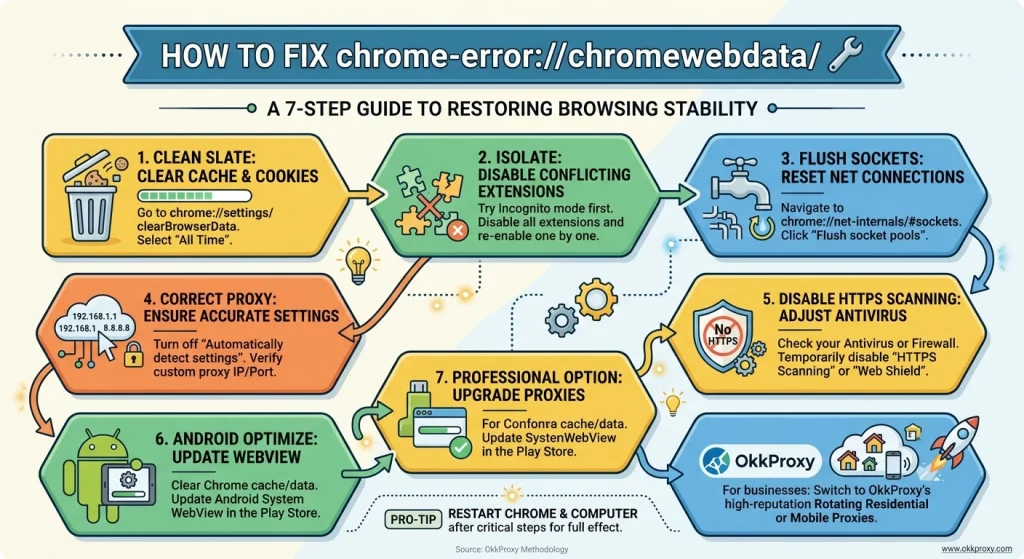
For results-driven users, downtime is lost revenue. Follow this structured approach to clear the error and regain stability.
1. The “Clean Slate” Method: Cache and Cookies
Most occurrences of chrome-error://chromewebdata/ are caused by local data corruption.
- Open Chrome and navigate to chrome://settings/clearBrowserData.
- Select All Time as the range.
- Ensure Cookies and Cached images/files are selected.
- Click Clear Data and restart the browser.
2. Isolate Browser Extensions
SEO professionals often use dozens of extensions for rank tracking and site analysis. These can conflict.
- Open an Incognito Window (Ctrl+Shift+N).
- If the error does not appear in Incognito, one of your extensions is the culprit.
- Go to chrome://extensions/ and disable them one by one to find the source of the conflict.
3. Resolve Chrome Error chromewebdata on Android
Mobile users often see Chrome error chromebdata Android when using WebView-based applications.
- Update System WebView: Go to the Google Play Store and ensure “Android System WebView” is updated.
- Clear App Data: Go to Settings > Apps > Chrome > Storage > Clear Cache.
The Pro Advantage: Using High-Quality Proxies to Prevent Errors
For businesses performing web scraping or ad verification, the chrome-error://chromewebdata/ issue is often tied to poor proxy performance. If you are using low-quality, shared proxies, the server may reset the connection, leading Chrome to display this error.
Why Your Choice of Proxy Matters
| Proxy Type | Stability Level | Best Use Case |
| Rotating Residential Proxies | Very High | Avoiding IP bans and chromewebdata errors during large-scale scraping. |
| Static ISP Proxies | Excellent | Long-term account management and social media marketing. |
| Rotating Mobile Proxies | Highest | Bypassing the toughest bot detection and mobile-specific SEO checks. |
| Static Mobile Proxies | High | Stable app testing and localized ad verification. |
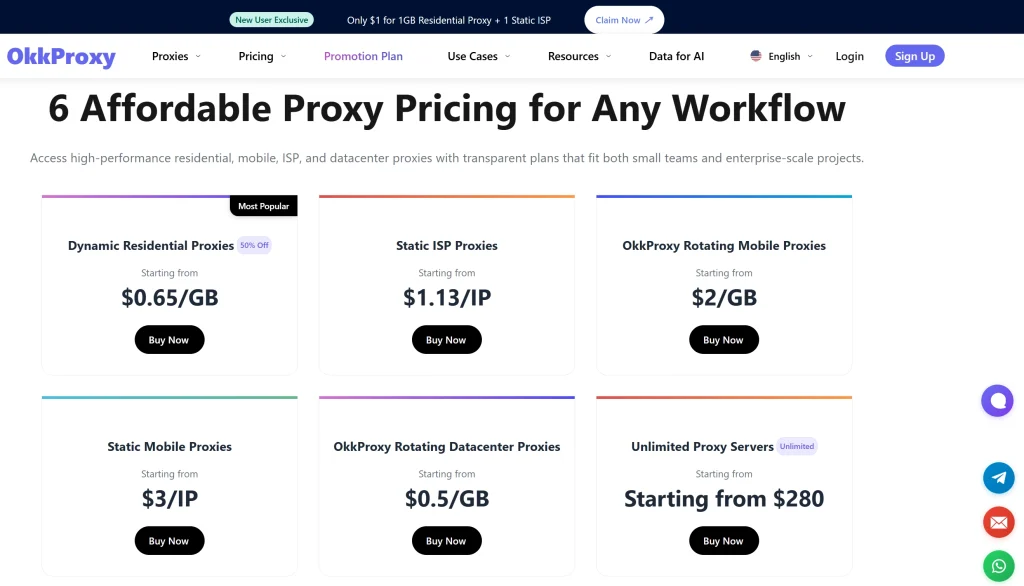
| Rotating Datacenter Proxies | Medium | High-speed tasks where IP reputation is less critical. |
At OkkProxy, we provide rotating residential proxies that utilize real household IPs. Because these IPs have high trust scores, they are far less likely to be “reset” by target websites, which effectively eliminates the connection drops that cause the chrome-error://chromewebdata/ loop.
Advanced Technical Fixes for Developers and Analysts
If the basic steps didn’t work, the issue likely resides in your network stack.
4. Flush the Socket Pool
Chrome maintains internal “sockets” for open connections. If these hang, you get the chromewebdata error.
- Type chrome://net-internals/#sockets into your address bar.
- Click Flush socket pools.
- This forces a fresh handshake for every new request.
5. Correct Misconfigured Proxy Settings
For SEO teams using global networks, a misconfigured local proxy is a common culprit.
- In Windows, search for Proxy Settings.
- Ensure “Automatically detect settings” is ON unless you are manually using static ISP proxies.
- If you are using a manual proxy, verify the IP and Port are still active.
6. Disable Antivirus “HTTPS Scanning”
Many security suites like Avast or Bitdefender intercept browser traffic. This “Man-in-the-Middle” approach can break the SSL handshake.
- Go to your Antivirus settings.
- Look for Web Shield or HTTPS Protection.
- Temporarily disable it to see if the chrome-error://chromewebdata/ error resolves.
Real-World Case Study: Solving Data Inaccuracy for an SEO Agency
The Client: A mid-sized digital marketing agency performing daily rank tracking across 50 countries.
The Problem: Their automated tools were returning frequent occurrences of “chrome-error://chromewebdata/”, resulting in 15% data loss every 24 hours.
The Investigation: The agency was using cheap datacenter proxies. The target search engines were detecting the “datacenter” footprint and dropping the connection before the page fully loaded.
The Solution: We migrated their workflow to OkkProxy’s rotating mobile proxies.
- Result: The error rate dropped to 0.2%.
- Takeaway: By using rotating mobile proxies, the agency presented as a legitimate mobile user, preventing the server-side resets that trigger the chromewebdata fallback.
Practical Takeaways for Stability
- Monitor IP Health: Use proxies with a low failure rate to avoid browser fallbacks.
- Update Regularly: Keep Chrome and Android System WebView current.
- Diversify Proxy Types: Use static mobile proxies for account logins and rotating residential proxies for data extraction.
FAQ: Frequently Asked Questions about chromewebdata
Why does my browser say chrome-error://chromewebdata/ instead of a normal error?
This happens when the error occurs during the “initialization” of the navigation. Chrome hasn’t even had the chance to load the standard “Aw, Snap!” page, so it shows this internal system address instead.
Can a slow internet connection cause this?
Yes. If the connection times out mid-request, especially while using a high-latency proxy, the browser may fail to render the error page properly.
Is OkkProxy compatible with all Chrome versions?
Absolutely. Whether you are using static ISP proxies or rotating datacenter proxies, our infrastructure is designed to integrate seamlessly with Chromium-based browsers and headless automation tools like Selenium or Puppeteer.
Conclusion: Stop the Error, Start Scaling
The chrome-error://chromewebdata/ error is more than just a minor glitch; for professionals, it’s a barrier to accurate data and stable operations. While clearing your cache is a good start, the long-term solution lies in a robust network configuration.
By leveraging professional tools—such as static ISP proxies or rotating residential proxies—you ensure that your browser always has a clear, trusted path to the web.
Ready to upgrade your connection stability? Explore OkkProxy’s Premium Solutions and eliminate browser errors for good.