Summary
Proxy speed measures ping latency and bandwidth, whereas proxy quality evaluates IP reputation, ASN/subnet purity, trust score, and request success rates (HTTP 200). While high-speed datacenter proxies offer low latency (50ms), they frequently fail on anti-bot systems like Cloudflare or Akamai due to subnet fatigue. High-quality rotating residential proxies, static ISP proxies, and mobile proxies maintain superior trust, guaranteeing high success rates for scraping, multi-account management, and marketing automation without getting blocked.
Introduction
When engineering data collection pipelines or managing multi-account marketing operations, many teams fall into a classic technical trap: evaluating proxy performance solely through high speed proxy metrics. They run a proxy speed test, observe low ping times, and assume their setup is fully optimized.
However, in modern web scraping and anti-detection environments, proxy speed and proxy quality are fundamentally different metrics. Speed measures how fast an IP or server responds (latency and raw throughput), whereas quality measures how well that IP blends in with organic residential traffic, survives target security filters, and completes real-world tasks without triggering CAPTCHAs, rate limits, or IP bans.
Understanding this distinction is the single most critical factor in achieving stable, high-yield automation. In this comprehensive guide, we examine why a fast speed proxy can still fail, how to evaluate true performance, and how OkkProxy delivers enterprise-grade infrastructure across rotating residential proxies, static ISP proxies, and mobile networks.
Speed vs. Quality: The Core Metrics Defined
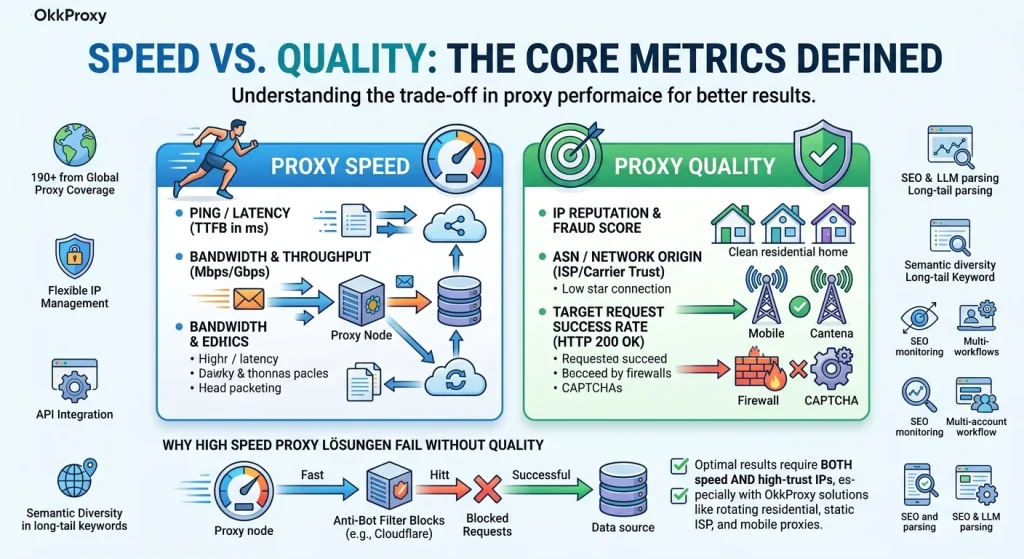
To understand why high-speed connections often result in blocked requests, we must break down the key technical differences between network speed and IP quality.
Speed: Latency and Bandwidth
- Latency / Time to First Byte (TTFB): The time (in milliseconds) it takes for a request packet to travel from your client through the proxy server to the target website, and for the target server to send back its first byte.
- Bandwidth & Throughput: The volume of data transferred per second (e.g., Mbps or Gbps).
- Network Routing: Heavily influenced by the physical distance between your machine, the proxy node, and the target server.
Quality: Reputation and Request Success Rate
- IP Cleanliness & Reputation: Evaluated against threat intelligence databases. Clean IPs carry a fraud score near zero.
- Network & Autonomous System Number (ASN) Diversity: Organic residential IPs assigned by consumer Internet Service Providers carry significantly higher trust than commercial hosting subnets.
- Request Success Rate (HTTP 200 OK vs. HTTP 403 / 429): Measured by whether a request successfully extracts data or completes a transaction, rather than how fast the TLS handshake finishes.
Why the Fastest Proxies Often Fail: The “Speed Trap”
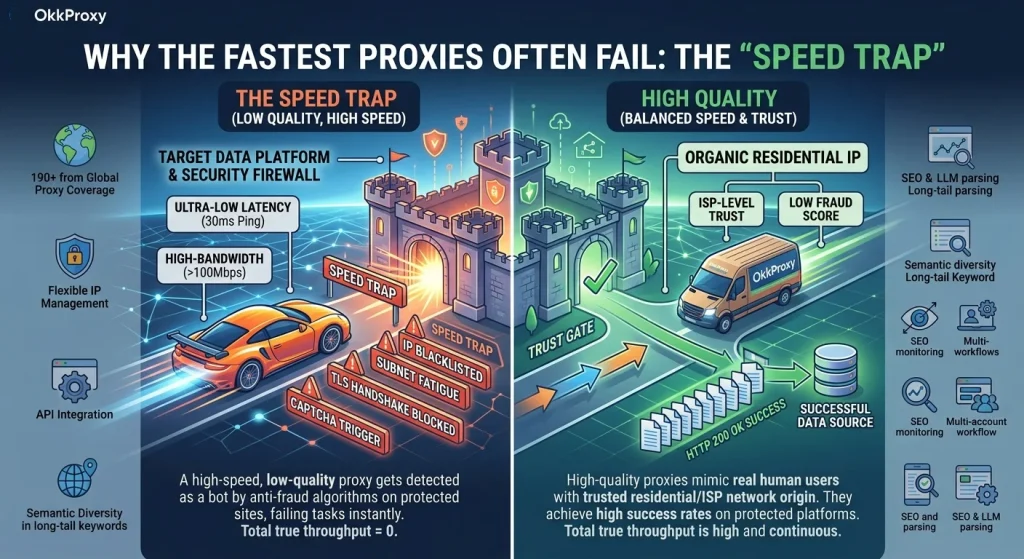
A common mistake made by digital marketers and developers searching to buy high speed proxy packages is selecting datacenter proxies purely based on speed benchmarks.
The Speed Trap Explained
- Subnet Fatigue: Millions of fast IPs concentrated in a single datacenter subnet get detected and blacklisted rapidly. When a security firewall sees thousands of concurrent requests originating from the same hosting provider, it blocks the entire IP block.
- Reauthentication Overhead: If a fastest high speed data proxy drops its session or triggers a login challenge, the time spent solving CAPTCHAs or re-authenticating wipes out any initial speed gains.
- The False Benchmark: A 50ms response time is entirely useless if the target site’s anti-bot system flags and returns an HTTP 403 Forbidden on the very first request.
For deeper insights into how IP pools affect performance, read our guide on Rotating Residential Proxies Explained.
Comparing Proxy Types: Speed, Stability, and Task Success Rate
Different proxy architectures offer distinct trade-offs between speed, latency, cost, and anti-detection capabilities.
| Proxy Type | Average Latency (Ping) | Fraud Risk Score | Ban Rate on Protected Sites | Best Use Cases |
| Datacenter Proxies | Ultra-Low (<50ms) | High (datacenter ASN) | High (>60%) | Large-scale unprotected web scraping, local caching, non-sensitive API calls. |
| Rotating Residential Proxies | Moderate (150ms–350ms) | Ultra-Low (Organic ISP) | Very Low (<2%) | Scalable SERP tracking, price intelligence, AI training data extraction. |
| Static ISP Proxies | Low (<100ms) | Ultra-Low (Residential ASN) | Very Low (<1%) | E-commerce multi-account management (Amazon, eBay), Facebook Ads Manager. |
| Mobile Proxies (4G/5G) | High (200ms–500ms) | Minimal (Carrier CGNAT) | Lowest (<0.5%) | Social media automation (TikTok, Instagram), crypto arbitrage bots, strict risk control bypass. |
Matching Proxy Infrastructure to Your Business Use Case
To achieve optimal results, businesses must align their proxy selection with their exact operational requirements.
Use Case 1: E-Commerce & Marketplace Multi-Account Operations
- Primary Need: Uninterrupted, long-term sessions with zero IP drift.
- Why Pure Speed Fails: Changing IP addresses or using datacenter subnets triggers immediate account security locks.
- Recommended Architecture: Static ISP Proxies. Combining residential network trust with datacenter-grade routing speeds, dedicated static ISP proxies provide the stability required to manage store profiles without security flags.
Use Case 2: Public Web Scraping & SERP Tracking
- Primary Need: Massively parallel requests across global regions.
- Why Pure Speed Fails: High request concurrency from a static IP list triggers rate limits (HTTP 429) within seconds.
- Recommended Architecture: Rotating Residential Proxies. Rotating IPs per request or session ensures requests originate from authentic household connections across 190+ countries.
Use Case 3: High-Frequency Crypto Arbitrage & Sneaker Bots
- Primary Need: Real-time processing with low latency and anti-detection capabilities.
- Why Pure Speed Fails: Target endpoints use aggressive anti-bot mitigation. High speed without high reputation results in instant IP bans.
- Recommended Architecture: High Speed Mobile Proxies & Datacenter Proxies. Combining high speed proxies for crypto arbitrage bots with carrier CGNAT IPs guarantees low ban rates during volatile trading spikes.
Practical Guide: Measuring Effective Proxy Performance (Beyond Ping)
Relying on standard speed test tools often produces misleading results because they measure direct server bandwidth rather than real-world target responses.
Step 1: Measure Real Time to First Byte (TTFB)
Instead of running a basic ping test, use cURL to measure the exact handshake and connection time through your proxy:
Bash
curl -o /dev/null -s -w “Connect: %{time_connect}s | TTFB: %{time_starttransfer}s | Total: %{time_total}s\n” \
–proxy http://username:password@proxy.okkproxy.com:8080 \
https://target-e-commerce-site.com/api/v1/product/12345
Step 2: Calculate the Proxy Speed Loss Percentage & Success Rate
Execute a test batch of 1,000 requests against your target domain and evaluate the metrics.
Step 3: Calculate Effective Throughput (The True Metric)
If Provider A delivers a 50ms latency but yields a 20% success rate, its effective request throughput is significantly lower than Provider B, which offers a 200ms latency with a 99% success rate.
How OkkProxy Balances Speed and Quality Across Product Lines
At OkkProxy, network architecture is engineered to eliminate the trade-off between raw speed and high IP quality. By deploying low-latency routing nodes over pure residential and carrier networks, OkkProxy guarantees maximum task success rates. For integration workflows, check out our technical documentations.
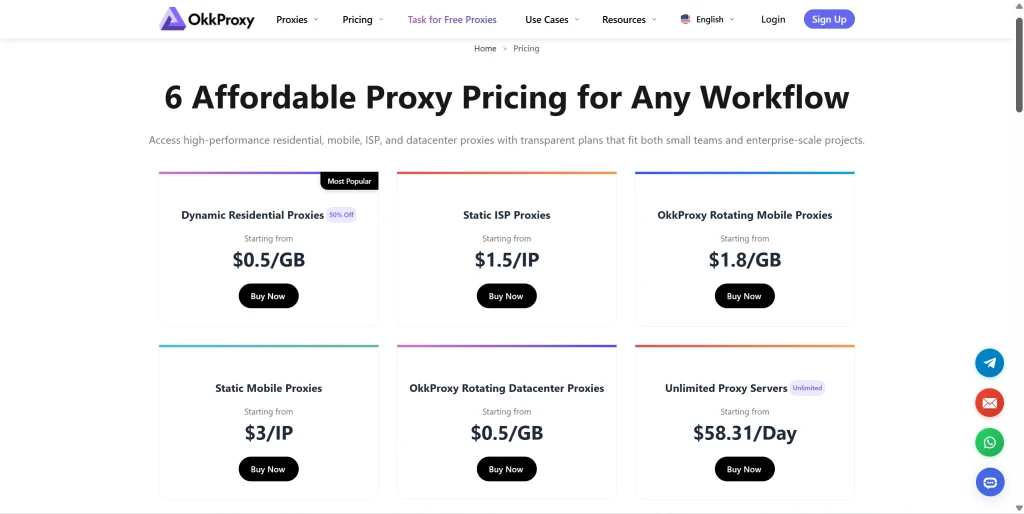
OkkProxy Pricing & Product Overview
- Rotating Residential Proxies: Starting from $0.50/GB (Promax/Pro/Mini tiers). Features over 80M+ premium IP pools across 190+ countries with country and city-level targeting.
- Static ISP Proxies: Normal plans at $1.50/IP (7 Days) and $5/IP (30 Days); Premium Native plans at $4.50/IP (7 Days) and $8/IP (30 Days).
- Rotating Mobile Proxies: Scalable pricing from $1.80/GB to $3.20/GB utilizing authentic 4G/5G carrier networks.
- Unlimited Residential Proxies: Daily flat-rate packages starting from $58.31/day offering up to 50,000 QPS concurrency.
Tip: Use coupon code PAY2 during checkout to enjoy an exclusive 10% OFF on all recharges.
Troubleshooting & Optimization Checklist
Use this checklist to diagnose performance bottlenecks in your proxy network:
- Verify IP Cleanliness: Check target IP fraud scores via threat intelligence databases before deploying large scraping jobs.
- Optimize Protocol Selection: Ensure SOCKS5 or HTTP/HTTPS protocols are matched correctly to your client software.
- Select Geographic Proximity: Pick proxy egress locations physically close to your target site’s server infrastructure to minimize round-trip time (RTT).
- Pair with Anti-Detect Browsers: Ensure your proxy setup is paired with fingerprint management tools like AdsPower, Multilogin, DICloak, or MoreLogin to prevent WebRTC leaks.
- Audit Nginx / Server Reverse Proxy Settings: If running local proxy gateways, tune server settings (e.g., enabling keepalive connections) to optimize routing speed.
Frequently Asked Questions (FAQ)
Is HTTP or SOCKS5 faster?
Generally, SOCKS5 proxies offer lower latency for raw packet transmission because they operate at a lower protocol layer (Layer 5) without rewriting HTTP headers. However, HTTP/HTTPS proxies are better optimized for web traffic handling, header inspection, and web scraping automation.
What does a high quality proxy mean?
A high quality proxy refers to an IP address that possesses a clean historical reputation, zero blacklist records, organic residential or mobile network origin (ISP/Carrier ASN), and high request completion rates (HTTP 200 OK) when accessing protected web targets.
Can a proxy server speed up internet connections?
In most cases, a proxy introduces a minor routing delay. However, a caching proxy server can speed up internet access for previously visited resources by serving local cached copies rather than fetching data from the origin server repeatedly.
Why are proxies generally slower than direct connections or VPNs?
Proxies route data packets through an intermediary node, adding physical distance and processing overhead. Additionally, residential proxies rely on consumer ISP hardware, which inherently carries higher latency than dedicated cloud data centers.
What is a good proxy speed for scraping and automation?
A good proxy speed for web scraping is defined by a Time to First Byte (TTFB) under 300ms, accompanied by a target task success rate above 95%.
Summary Checklist for Proxy Selection
To ensure your proxy network performs reliably, verify the following baseline requirements before scaling:
- High request success rate (HTTP 200 OK > 95%)
- Low IP risk score on major security databases
- Proper geographic alignment with the target destination
- Balanced combination of routing speed and IP trust
- Integration with anti-detect browser environments for session isolation
By prioritizing IP quality and success rates over raw ping speed, you build a resilient, scalable web scraping and account management infrastructure capable of navigating modern web security systems.